
Escape the Egg Organization and Unlock Scalable Growth
Many companies struggle with product management that feels broken: discovery is missing, stakeholders dictate solutions, and engineering is stuck in firefighting.
The root cause is what we call the "Egg Organization", a structure where product teams sit in the yolk, surrounded by project-driven demands that keep them trapped.
This talk shows how organizations can break out of this pattern. By aligning leadership, sales, finance, and product around outcomes rather than projects, companies unlock scalable growth, faster delivery, and stronger customer impact. We’ll share how small lighthouse teams can lead the way and how shifting incentives and mindset turns product management from backlog administration into a true driver of business success.
Attendees will leave with a clear metaphor to explain their own challenges and practical steps to start building a product organization that scales.
Rewatch the Keynote
Want to join the next just product conference to see keynotes like this live onsite or in the livestream?
Make sure to get your ticket today
The Egg Organization: Why So Many Companies Get Stuck Between Project and Product
Every company wants to scale. That is often the reason leaders decide to “go product.” But many B2B organizations that try to move from project mode to product mode get stuck halfway.
They become what Thomas Hartmann calls an Egg Organization, a company that looks like a product organization on the inside but still acts like a project company on the outside.
1. How It Feels to Work in an Egg Organization
Working in an Egg Organization is confusing and exhausting.
Inside the yolk, the product and tech teams try to work like a modern product company: they talk about discovery, iterations, OKRs, and outcomes.
But outside the yolk, the rest of the organization still thinks in projects.
Sales, operations, and management throw ideas over the fence and expect deadlines, usually “as soon as possible.”
It is a clash of mindsets. One side says, “Let’s test and learn.” The other says, “I already know what we need, just build it.
”You want to talk to customers, and someone tells you, “Why bother? We already know what they want.
”You want to apply best practices, and leadership says, “Fine, as long as you deliver on time.”
The result is chaos. You have more ideas than you can build, endless debates about priorities, and constant pressure to deliver without understanding why.
It feels like everyone wants progress, but nobody agrees on what that actually means.
2. How We Think About Egg Organizations
Egg Organizations usually start with good intentions.
Many B2B software companies begin with one big customer. They build exactly what that customer needs, and it works. Then comes the second client, similar but not identical. A few changes here, a few customizations there.
At first, this seems fine. But soon the company is managing ten clients, each with slightly different versions of the same product. Engineers are drowning in maintenance, and the product roadmap turns into a patchwork of one-off requests.
Thomas calls this project stacking, layering projects on top of each other until everything breaks.
As one CEO put it, “We shipped more with ten engineers in the early days than we do with a hundred today.
”This happens because the company is still thinking in project logic.
A customer asks for something, sales fixes the scope, and product and engineering are told to deliver. The pricing is simple: time, materials, and a bit of margin.
There is no segmentation, no validation, and no clear strategy.
And because everything runs as projects, prioritization and roadmapping become a constant battle.
Salespeople are trained to make things bigger: bigger scope, bigger projects, bigger deals. Product management ends up as a scheduling department, not a strategic one. Everyone fights for capacity, and the roadmap becomes a negotiation of who screams the loudest rather than what drives the most value.
In contrast, product companies use filters to simplify decisions.They segment their markets and focus on customers who fit their strategy. They price custom requests higher so that non-scalable work filters itself out. They run product discovery to test ideas before investing heavily.
Step by step, this turns the roadmap from a chaotic wishlist into a focused strategy that everyone understands.
Product companies think in segments, not clients. They focus on building things that can be sold again and again.
They ask “Should we build this?” before “Can we build this?”And that small change in thinking is what separates scalable companies from those forever trapped in firefighting mode.
3. What You Can Do to Change Your Organization
You cannot fix an Egg Organization by improving only your product department.
Better sprints, new frameworks, or discovery rituals will not solve the real problem if the rest of the company still thinks in projects.
As a product leader, your job is to change the environment your team operates in. That means aligning leadership on what scalability really means and what drives it.
Start by asking two simple questions:
- Why do we want to become a more product-driven company?
- What truly gives us scalability and profitability?
To drive this kind of transformation, product leaders need to act like facilitators, not gatekeepers.Map how decisions are made. Visualize how requests flow through the organization. Show the connection between decisions, complexity, and scalability. When people see the bigger picture, they start changing their behavior.
Or, as Thomas puts it:
“Aligning leadership on what needs to change to become more scalable is your game plan to unlock product mode.”
The Takeaway
1. If your organization feels stuck, you are probably sitting inside the egg.
2. To break out, you have to change not just how you build products, but how your company thinks about building them.
3. Scalability is not born inside the product department; it starts with a shared mindset across the entire organization.
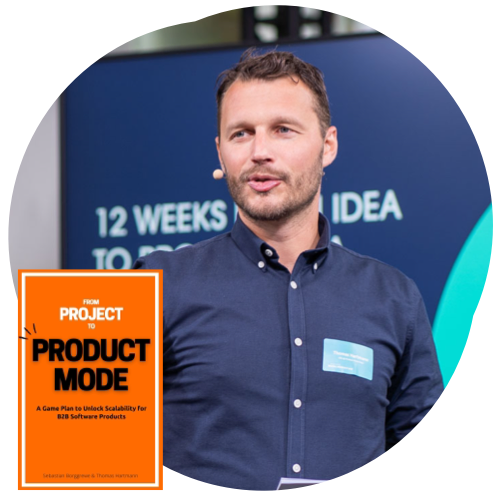
Thomas Hartmann and Sebastian Borggrewe explore this transition in more depth in their book From Project to Product Mode, where they outline how to redesign structures, incentives, and culture to truly scale through product thinking.
Thomas Hartmann
Co-Founder @ Product Masterclass · Speaker · Author of From Project to Product Mode
Thomas Hartmann is the co-author of From Project to Product Mode and founder of Product Masterclass. He helps B2B product teams scale by combining strategy, customer insight, and structure. His coaching supports corporates like Siemens and Bosch, as well as scale-ups and SEMs like Xentral, Compleet, and Hartmann.
Get your ticket for 2026
Save up to 200€ with our normal bird ticket