Take your team to the next level
Request additional information for an Inhouse Cohort



Like our articles?
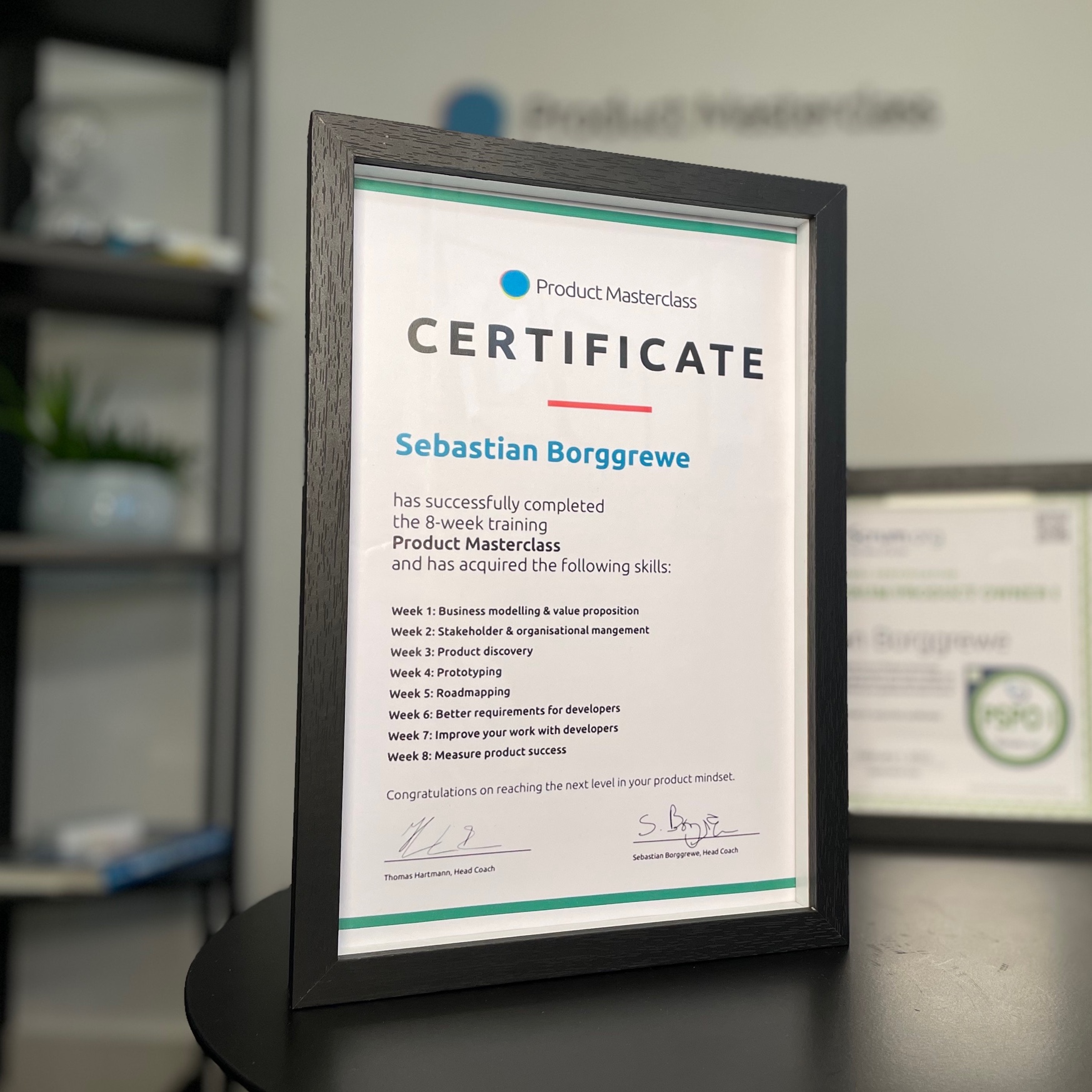
If you like our free articles, why stop there?
Take the next step in your career with the Product Masterclass — the 8-week program that turns you into an AI-native product manager.
From Solution Space Back to the Problem
Thomas Ostendorf is a fullstack engineer. He fell into the Product Manager role because no one else could take it. Eight weeks after Product Masterclass, he runs more than a dozen extra Discovery interviews and makes product decisions with the conviction that they hold.
Thomas Ostendorf is a fullstack engineer. He fell into the Product Manager role because no one else could take it. Eight weeks after Product Masterclass, he runs more than a dozen extra Discovery interviews and is making product decisions with the conviction that they hold.
Thomas Ostendorf works at Orbit Labs, a Hamburg consultancy with a second site in Barcelona, embedded with a large corporate client in a complex industrial domain. His background is engineering. He fell into the Product Manager role when his team grew from eight to twenty five people and the client needed someone to carry digital product development. His colleagues on the client side are domain experts, not digital product people. He is the only one.
When he signed up for Product Masterclass, he described his motivation like this:
“Instead of burying my head in the sand and saying this is silly, I didn't want PM. I fell into it, so I want to get good at it.”
Understand the problem first
Asked what changed in how he sees Product Management, the answer came right away.
Problem before solution
“The thing that comes to mind first is putting more weight on properly run Discovery interviews. And not jumping into the solution space too quickly.”
Thomas frames it with the clarity of someone who knows the reflex from the inside:
The engineer's reflex
“As an engineer, you usually feel the urge to just solve problems. So that's actually something you have to learn to step away from.”
What changed in his daily work: he has run ten to fifteen additional Discovery interviews across different parts of the domain. The ongoing exchange with end users has become routine.
Deciding with evidence
“It gives me a lot more confidence. Because I understand their problems much better. And then at some point I can generate a possible solution from that. I think this makes me a better Product Manager than I was before. Because it's evidence based.”
Want to build your own AI workflow?
Product Masterclass is an eight week intensive for Product Managers in the AI era.
See the next cohorts →What the AI skills do in daily work
Thomas runs the interviews himself. What AI does for him is the work around them.
“I have these two skills from the start of PMC: Mom Test, and Jobs to be Done. I run them over every interview.”
The Mom Test skill checks whether the interview itself was conducted well. Personal learning loop. The Jobs to be Done skill works on the content:
“Jobs to be Done is interesting, because I can hold it up against the backlog. What stories are already planned. Where are the gaps? Where do I need another interview to figure out what should actually be built?”
In daily work, AI shows up mainly as a sparring partner. When he writes features and stories, he prompts Claude into the role of a senior engineer:
“Act as a senior engineer. Ask me anything that sounds unclear.”
This kind of Discovery has become routine for Thomas.
Building his own AI context
Asked what helped most, Thomas listed two things. Discovery was one. The second came right after:
“The other big one: the whole topic of building context and using it.”
He has started building, step by step, an AI context for his company following the PMC pattern. Strategy extracted from the website. Design from the code base. A company retro that lived on Post its, which he turned into text via AI from the photos and then categorized. The job postings, which often say more about what the company stands for than anywhere else.
What convinces him on the engineering side:
Context, versioned
“From an engineering angle that's fascinating. Versioning, putting it in a Git Repo, makes total sense to me.”
The cleaned up context is something Thomas now passes on to colleagues step by step, so they can work with it too.
What shifted
Eight weeks were enough to shift two things. The first shift is how Thomas works with end users. More interviews, more domain understanding, more confidence when prioritizing.
The second is his AI work. Today, AI skills run like small specialists over every interview. And an AI context for his own company is growing step by step, carrying more and more workflows over time.
“Overall, I definitely learned something. I want to emphasize that. And I liked hearing different speakers too.”
More from the conversation
Why he leaned in
Two skills, every interview
Checking the backlog
Claude as senior engineer
At Product Masterclass, we train Product Managers to work effectively in the AI era. Our intensive 8 week program covers everything from customer interviews to vibe coding to building your personal AI workflow. See the next cohorts.
Discover where product management is heading
Stay up to date with our Product Newsletter and do not miss out on free articles, videos, templates, events on Product Management