Take your team to the next level
Request additional information for an Inhouse Cohort



Like our articles?
If you like our free articles, why stop there?
Take the next step in your career with the Product Masterclass — the 8-week program that turns you into an AI-native product manager.
Vibe Coding vs. Vibe Engineering: Why Easy Prompts Won't Build Great Products
AI makes development feel like magic. But vibe coding without clear requirements just accelerates chaos. Here is how vibe engineering closes the gap.
Vibe Coding vs. Vibe Engineering: Why Easy Prompts Won't Build Great Products
AI makes development feel like magic. But magic without method creates chaos.
I've spent the last weeks deep in what people call "vibe coding" - using AI to build software, prototypes, and tools. And I've learned something that won't surprise anyone who's ever worked in product management: the tool is only as good as the process around it.
Here's what I mean.
The Vibe Coding Trap
You open Claude, Cursor, or Lovable. You write a prompt. Seconds later: a shiny UI appears on your screen. Your first reaction? "I'm a genius. I can build anything."
And for about five minutes, that feeling holds up.
Then the button doesn't work. A fix introduces two new bugs. The layout breaks on mobile. You realize the AI made assumptions about your data model that make no sense. You spend hours cleaning up what took seconds to generate.
This is the vibe coding trap. It feels productive. It looks impressive. But underneath the surface, you're accumulating problems faster than you're solving them.
Here's the thing nobody tells you: anybody can write a prompt and get a shiny object. The problem is everything the AI had to guess about. Every undefined requirement, every unclear edge case, every architectural decision you didn't make - the AI just filled in the blanks with something random. And now you need to clean it all up.
The One-Prompt Thought Experiment
Imagine handing your engineering team a single prompt. No spec, no requirements doc, no architecture discussion. Just one sentence: "Build me a dashboard for customer analytics."
They're not allowed to ask questions. Not a single one. They just have to build what they think you need.
That sounds absurd, right? You'd never do that to your team. You know exactly what would happen - they'd build something, but it wouldn't be what you actually needed. You'd waste weeks going back and forth.
And yet, that's exactly what most people do with AI every single day.
Vibe Engineering Closes the Gap
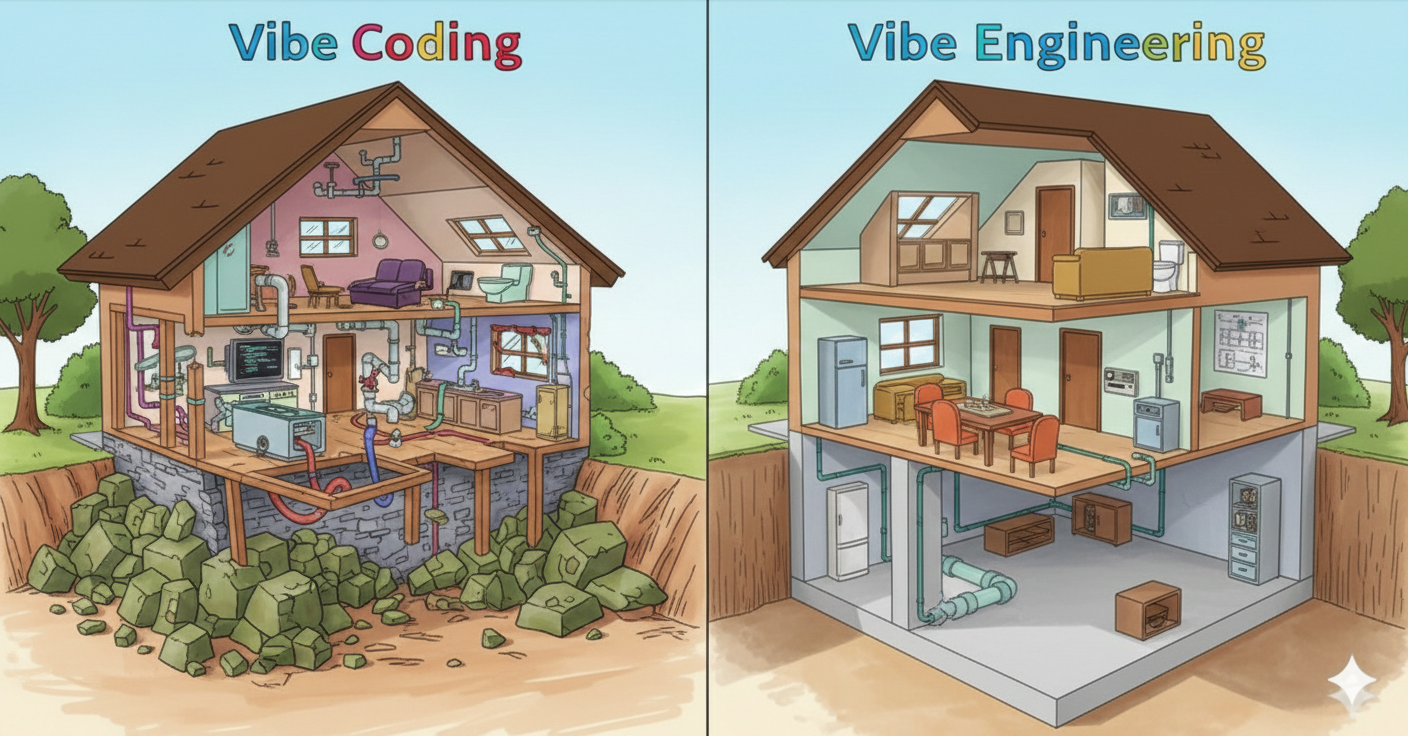
The difference between vibe coding and vibe engineering is the same difference between throwing a prompt at your team and actually running a proper product process.
Vibe engineering means AI is still the accelerator - but you give it something to accelerate toward.
Step 1: Use AI to generate the input, not the output.
Before you write a single line of code, you use AI to help you think:
- Define clearly what you're building (and what you're not building)
- Surface edge cases and open questions
- Map out how this integrates with existing architecture
- Define what "done" looks like - including tests and acceptance criteria
- Identify risks and constraints upfront
This is the planning phase. You're using AI as a thinking partner, not a code monkey. The result: a clear brief with real boundaries, context, and direction.
Step 2: Then use AI to execute.
Now the AI has what it needs. It understands the constraints. It knows what "good" looks like. It has context about your architecture and your users. And suddenly, the output is dramatically better - because the AI isn't guessing anymore. It's building within a well-defined space.
Without Direction, AI Accelerates Technical Debt
This is the part most people miss. AI doesn't just accelerate delivery. It accelerates everything - including mistakes, shortcuts, and technical debt.
Without clear direction and boundaries, you're not building faster. You're creating problems faster. The code works today but becomes unmaintainable tomorrow. The prototype looks great but falls apart when real users touch it.
The organizations that will win with AI aren't the ones writing the most prompts. They're the ones who invest in the input quality - the thinking, the clarity, the structure - before they hit "generate."
You Don't Need to Be Technical
Here's one more thing I want to be honest about: I'm not a technical person. My co-founder Sebastian still needs to explain GitHub to me sometimes. And that's fine.
Because here's what's changed: AI does the technical execution for me. I focus on the what and the why - the product thinking, the user understanding, the strategic clarity. AI handles the how. And along the way, I'm learning more about technology than I ever expected.
This is exactly what we teach in Week 3 of the Product Masterclass: Vibe Coding for Product Managers. Not how to become a developer. How to think clearly enough that AI can build what you actually need.
The Bottom Line
Vibe coding is fun. Vibe engineering is effective.
The difference isn't in the tools. It's in the process. It's in doing the product work before you start prompting. It's in treating AI the way you'd treat any high-performing team member - by giving them the context, the constraints, and the clarity they need to do great work.
The PMs who figure this out first will have an unfair advantage. Not because they can code. But because they can think - and now AI turns that thinking into reality at unprecedented speed.
At Product Masterclass, we train product managers to work effectively in the AI era. Our 8-week intensive program covers everything from customer interviews to vibe coding to building your personal AI workflow. Check out the next cohort
Discover where product management is heading
Stay up to date with our Product Newsletter and do not miss out on free articles, videos, templates, events on Product Management