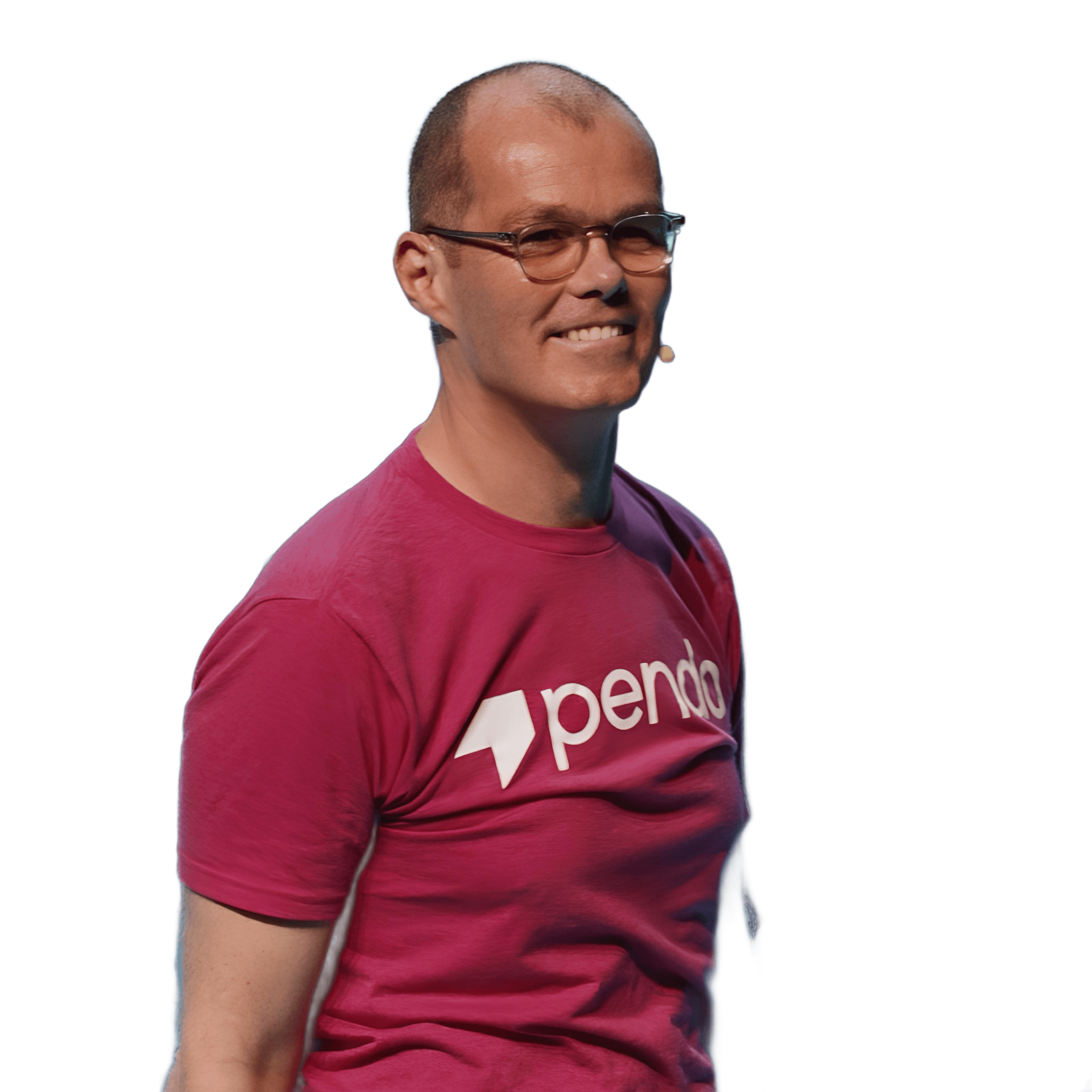
Eight talks, one room of 300 product people, and one theme that every speaker arrived at from a different direction: building got cheap. Judgment did not. Watch every talk again, jump to the moments that mattered, and take the summaries, takeaways and slides with you.

Scroll sideways. Each frame is one talk and its thesis in a sentence. Click to open the talk.
Read across the eight talks and a shared argument appears. Nobody on stage was selling AI as a feature. Everyone had already lived through the moment when engineering got four or ten times faster, and everyone was reporting what broke next. The patterns below are the editorial summary of that day. Each one links to the talks that made the point.
Martin Eriksson opened with the question that replaced 'can we build it': should we build it. Simina Pasat closed with its mirror image: it has never been easier to build something nobody wants, because the old cost of engineering used to force the boring questions early. In between, Dave Killeen admitted that taste is no longer the moat but the bottleneck, Faith Forster showed six ways teams skip the thinking because the build is so fast, and Felix Geelhaar warned that a roadmap that empties faster also ships every bad idea still on it. The job of product did not shrink. It moved up the stack.
Verena Graber told the story most concretely: medflex adopted agentic engineering, the backlog that had been five kilometres long was empty by Friday, and her chat filled with developers asking what to do next. Felix Geelhaar generalised it: AI speeds up the wiring an organisation already has, so 42 issues become 420 at review and the natural reflex is an agent that stamps 'looks good to me'. Dave Killeen called it the lemming problem, remove one constraint and the next one pops up, last week at CI. Simina Pasat saw the same inside GitHub, where one fast team stress tested release processes, reviews and a comms team built for a slower pace. The practical answer from all four: find where work piles up now, redesign around it, then look again.
Gopika Mohanan put it as a hiring scene: five new colleagues arrive on Monday, fast, tireless, confident and sometimes wrong, and the question is not how autonomous they should be but what context, roles and decision rights they get. Faith Forster's 'abandoned junior' is the same point from the failure side: hand an agent work without the rationale and conclude that AI does not work. Thomas Hartmann showed the operating system Product Masterclass built from exactly that insight, tools connected through APIs, business context, and about 46 skills that encode the processes. Dave Killeen writes down his 'truths' about the next twelve months and gives them to every team and agent. Felix Geelhaar wants that context in a queryable company layer, not in markdown files piling up in repos.
Faith Forster's first trap was tokenmaxxing: Uber ranked teams by AI usage, burned the year's budget by April, and could not name what customers got. Felix Geelhaar proposed replacing time to market with time to signal, how fast a customer reaction reaches the team that built the feature, against a survey finding that only 4 percent of teams can trace a roadmap decision to customer evidence. Simina Pasat traced how value moved from access to usage to impact and pricing followed, from per seat to per token to Intercom's 99 cents per resolved ticket, the same Intercom story Martin Eriksson used as the example of a company that scrapped its roadmap over a weekend. Dave Killeen was honest that he has no idea who uses Dex, and that love is not data.
Gopika Mohanan's core claim: working with agents forces every product manager, including the most junior, to practice delegation, decision boundaries, judgment and teaching from day one, skills people used to wait years to need. Thomas Hartmann described the new job as a three star chef at the pass, inspecting every plate the agents cook and sending back anything with a hair in the soup. Dave Killeen moved from a kanban of agents he had to shepherd to a single calm chat that brings back only the decisions he needs to make. Simina Pasat runs a Friday retro with Claude on what pushed the limits that week. The common thread: direction, review and the quality bar are the parts that stay human, and they need to be practised deliberately.
Every talk as full video with chapters, four to six highlight clips, a written summary, key takeaways, quotes, the Q&A and the slides as PDF.
AI broke an assumption under your strategy; find which one, go up the stack until one holds, and rebuild from there.
When AI makes delivery nearly instant, product becomes the bottleneck, and the old methods around it have to go.
AI made building fast, so teams skip the thinking; name the six traps and use the Makers Manifesto principles to rethink instead.
Connect AI to your tools and context, encode your workflows as skills, and the operational grind disappears, freeing you for strategy.
Working with AI agents forces every product manager, even the most junior, to practice classic product leadership skills from day one.
When AI makes building cheap, the advantage shifts to how fast you spot signal, redesign work around moving bottlenecks, and prove impact.
AI only speeds up the wiring you already have, so rewire the front with problem, proof and prototype first.
AI made building cheap but promising did not get cheaper, so build to learn and commit only to what deserves a promise.
The AI Workshop Stage (Catalina Turlea, Julia Bastian, Jens Rusitschka, Tim Herbig) was recorded on site. The recordings go to on-site ticket holders in the week after the conference and are not part of this page.
One file per talk and one file for the whole day: summary, takeaways, chapters with timestamps, quotes, Q&A and mentions. Plain Markdown, written for people and for context windows.
Need more depth? Each talk page also offers the full automatic transcript as Markdown.
Copy this into Claude, ChatGPT or your own agent. No download needed, the agent fetches the files itself.
Read the Just Product 2026 Main Stage recap and work with it: https://www.product-masterclass.com/just-product-2026/recap/downloads/just-product-2026-takeaways.md Per talk (summary, takeaways, chapters, quotes, Q&A): https://www.product-masterclass.com/just-product-2026/recap/downloads/02-martin-eriksson.md https://www.product-masterclass.com/just-product-2026/recap/downloads/03-verena-graber.md https://www.product-masterclass.com/just-product-2026/recap/downloads/04-faith-forster.md https://www.product-masterclass.com/just-product-2026/recap/downloads/05-thomas-hartmann.md https://www.product-masterclass.com/just-product-2026/recap/downloads/06-gopika-mohanan.md https://www.product-masterclass.com/just-product-2026/recap/downloads/07-dave-killeen.md https://www.product-masterclass.com/just-product-2026/recap/downloads/08-felix-geelhaar.md https://www.product-masterclass.com/just-product-2026/recap/downloads/09-simina-pasat.md Full transcripts, if you need the exact wording: https://www.product-masterclass.com/just-product-2026/recap/downloads/transcripts/<talk>-transcript.md (same file names, suffix -transcript) Then: which of these takeaways apply to my team and my product, and what would we change first? Quote the speaker when you use their point.
As the speakers presented them. Two talks were held without a deck we can share.