Take your team to the next level
Request additional information for an Inhouse Cohort



Like our articles?
If you like our free articles, why stop there?
Take the next step in your career with the Product Masterclass — the 8-week program that turns you into an AI-native product manager.
AI Made the Individual Faster. It Didn't Make the Team Faster. Yet.
Your team adopted AI. Everyone is faster. So why does nothing ship sooner? The problem isn't the tools. It's the handoffs between the people using them.
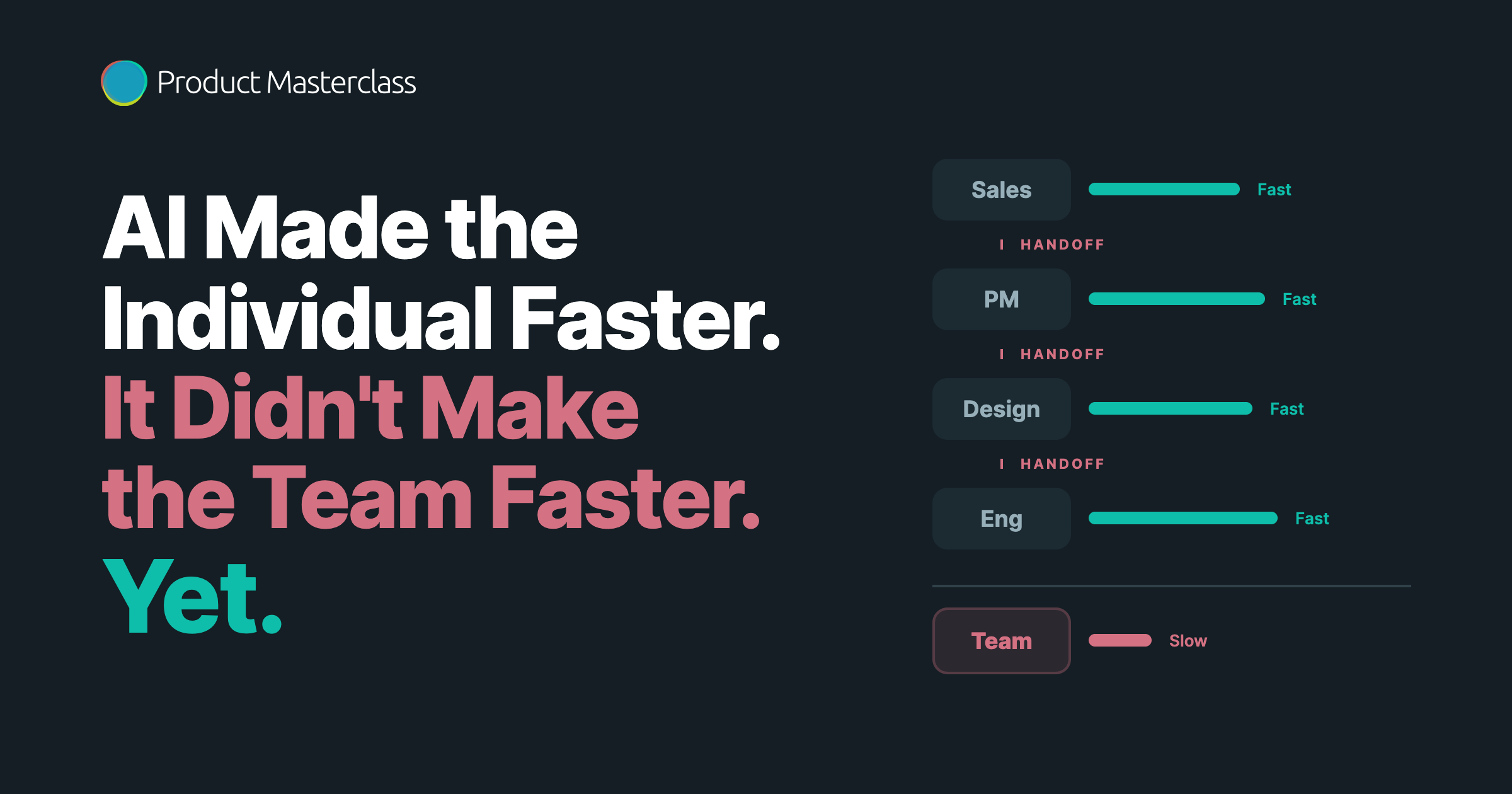
We made individual roles faster. Engineers ship code faster. PMs write specs faster. Designers prototype faster. But nobody touched the communication layer and processes between them.
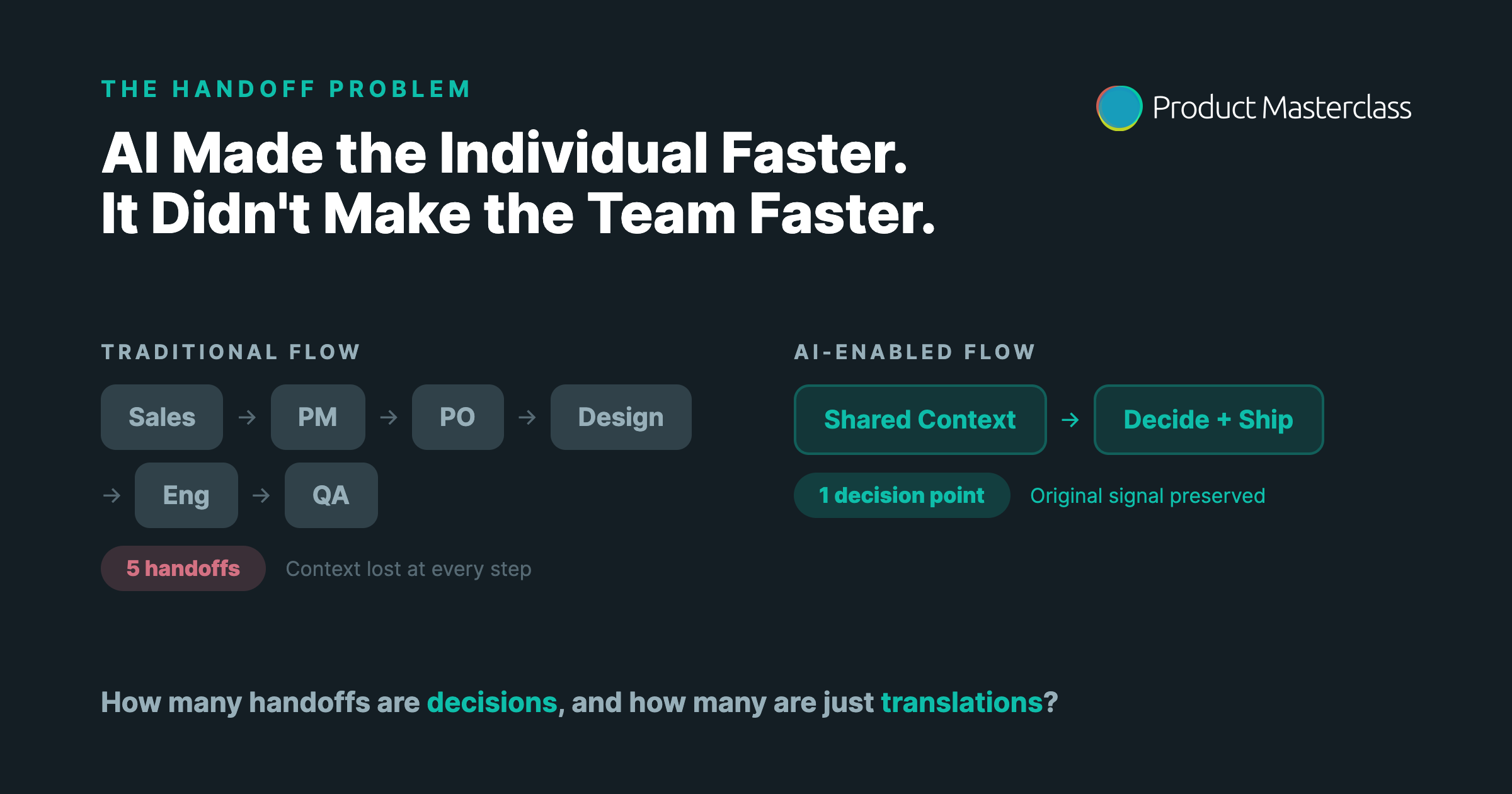
The traditional product development flow still looks like this:
Sales talks to a customer. Writes a summary. PM interprets it, writes requirements. PO breaks it into stories. Designer creates screens. Engineer builds it. QA tests it.
That's five handoffs. Each one loses context. Each one adds days. And each one translates information from one format to another.
Now think about what happens when you add AI to this chain. Each person gets 20 to 30 percent faster at their step. But the relay itself? Same number of handoffs. Same translation layers. Same days lost between steps.
You can't fix a relay race by making each runner faster. You have to question whether you need all those runners in the first place.
Every Handoff Loses Signal
Every time information passes from one person to another, time and context gets lost. A customer says "I abandon onboarding at step 3 because of notification overload." By the time that reaches engineering, it's a ticket that says "notification settings."
The original problem? Unrecognizable.
In a traditional workflow, this signal passes through four to five people. Each one translates. Each one loses something. Discovery insight becomes requirement becomes story becomes screen becomes code becomes test.
AI can make each translation faster. But faster translation of a broken telephone game still produces garbage.
The companies getting real results are doing something different. They're building what I call a shared context layer: a structured, accessible place where strategy documents, customer research transcripts, technical architecture, and the product backlog all live together. Not a wiki nobody reads. Not a Confluence graveyard. A working repository that both humans and AI can pull from when they need the full picture.
When AI can read the original customer call transcript AND the codebase AND the existing backlog, it doesn't need five humans to translate. It connects the dots itself.
Two Teams, Same AI Budget, Different Results
Here's a comparison I keep seeing play out.
Team A bought AI licenses for everyone. PMs use it to write faster PRDs. Designers use it for copy suggestions. Engineers use it for code reviews. Everyone is maybe 20 percent faster at their individual tasks.
Team B did something different. They built a shared context repository. Customer research, technical architecture, roadmap, strategy, all structured and accessible. When anyone on the team prompts AI, it has the full picture.
Their PM doesn't write PRDs from scratch and in isolation. They review AI generated drafts together with engineering and design, drafts that already reference the right customer interviews and technical constraints. Their designer doesn't tinker alone in Figma. They build design systems that AI can interpret and engineers can use directly. They prototype in code alongside the engineer, both working from the same context.
Team A made each role 20 percent faster. Team B made most of the handoffs unnecessary.
Both teams have the same tools. The difference is that Team A automated tasks. Team B redesigned the workflow.
Handoffs Slow Down How You Build. But There's a Second Bottleneck.
Handoffs slow down execution. But there's a layer above that's just as broken: how you decide what to build.
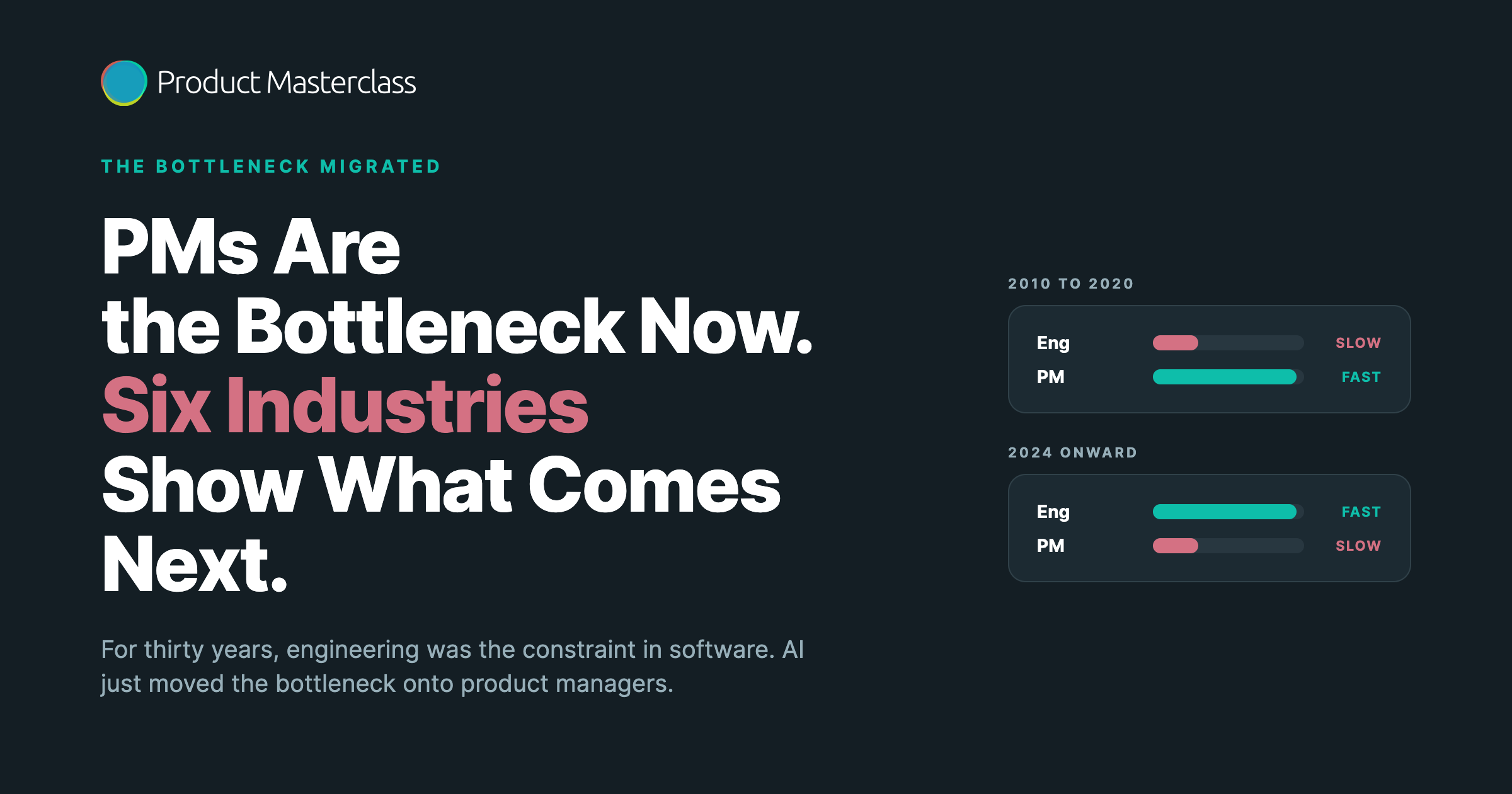
The execution engine went from six weeks to six days. The decision engine stayed at 90 day cycles.
We still do quarterly planning. We still set yearly goals. We still have monthly stakeholder reviews. The organizational cadence around product development hasn't changed at all. Features sit in backlogs waiting for the next planning window while the market moves on.
A senior product leader at a large German SaaS company told us: "Engineering is no longer the bottleneck for the first time in 20 years."
The new bottleneck? Us. The humans making decisions.
Product thinking was always the most valuable work. But for 20 years, engineering capacity was the excuse. "We can't test that idea, the team is fully booked until Q3." Now that excuse is gone. And that's uncomfortable. Because it means the only thing standing between an idea and a prototype is whether you actually understand the problem well enough.
So the bottleneck is twofold. Handoffs eat your speed on the way down. Slow decisions eat your speed on the way up. AI exposes both, but fixes neither.
A 15 Minute Exercise to Find Your Bottleneck
Want to find out where AI can actually save your team time? Try this.
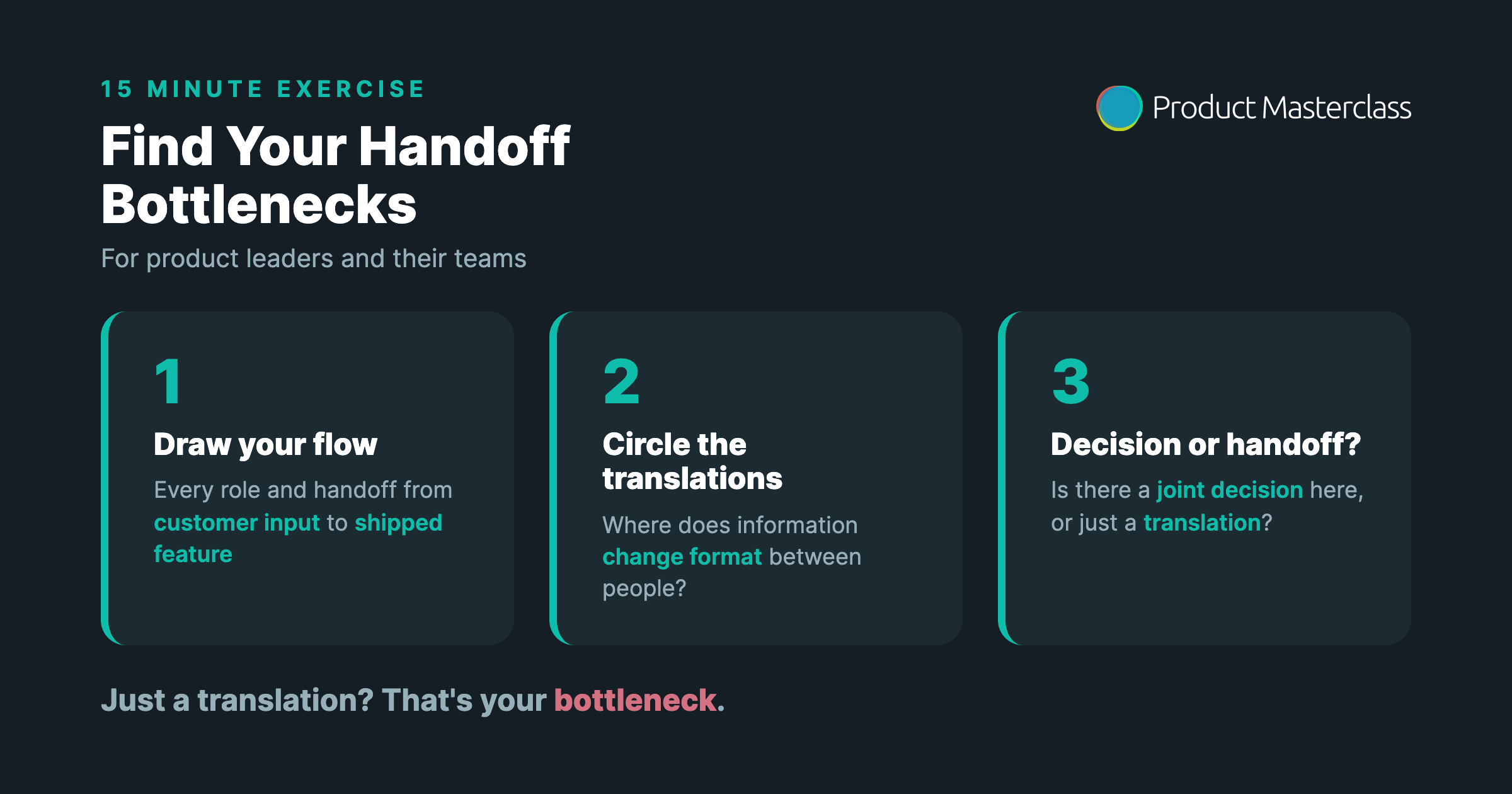
Step 1. Draw your product development flow on a whiteboard. From customer input to shipped feature. Every role, every handoff, every document that gets created along the way.
Step 2. Circle every point where information gets translated from one format to another. Customer words to PM doc. PM doc to user story. User story to design. Design to code.
Step 3. For each circle, ask: "Is there a decision being made here by both people, or is this just a handoff?"
If it's just a handoff, you found your bottleneck. That translation exists because of process, not because of judgment.
That's where AI can help. There is no need for translation if you can hand off the whole context. Give the next person direct access to the source.
A practical example: instead of PM summarizing a sales call into requirements, give the PM and AI access to the actual call transcript plus the codebase plus the backlog. AI synthesizes and drafts from the source. Meetings with Sales become pure decision meetings, not monthly handoffs of the "most important problems." PM reviews and decides instead of being stuck in endless alignment meetings. One circle removed. Days saved. Zero context lost.
Most teams have three to five of these unexamined translation layers. Each one is days or weeks of delay (we all know how hard it is to find a slot in other people's calendars) and signal loss waiting to be questioned. Some will turn out to be essential. Others will turn out to be habits from a time before shared context was possible.
This Is Not a Technology Problem
A CPO I spoke with recently said: "We don't have a 'this is how to do it' yet."
That's the real problem. Not the tools. The "how."
The companies I see winning are redesigning who talks to whom and how context flows between them. That has nothing to do with technology. That's an organizational design change. Pair it with enabling people to actually use AI and being curious about what's possible, and you are miles ahead.
Most companies aren't even having that conversation yet.
So here's a starting point: count your handoffs today. How many of them are decisions, and how many are just translations? If they are just translations, that's where you start.
At Product Masterclass, we train product managers to work effectively in the AI era. Our 8-week intensive program covers everything from customer interviews to vibe coding to building your personal AI workflow. Check out the next cohorts
Discover where product management is heading
Stay up to date with our Product Newsletter and do not miss out on free articles, videos, templates, events on Product Management