Take your team to the next level
Request additional information for an Inhouse Cohort



Like our articles?

If you like our free articles, why stop there?
Take the next step in your career with the Product Masterclass — the 8-week program that turns you into an AI-native product manager.
PMs Are the Bottleneck Now. Six Industries Show What Comes Next.
For thirty years, engineering was the constraint in software. AI just moved the bottleneck onto product managers. Six historical industry parallels and what they teach us about the structural response.
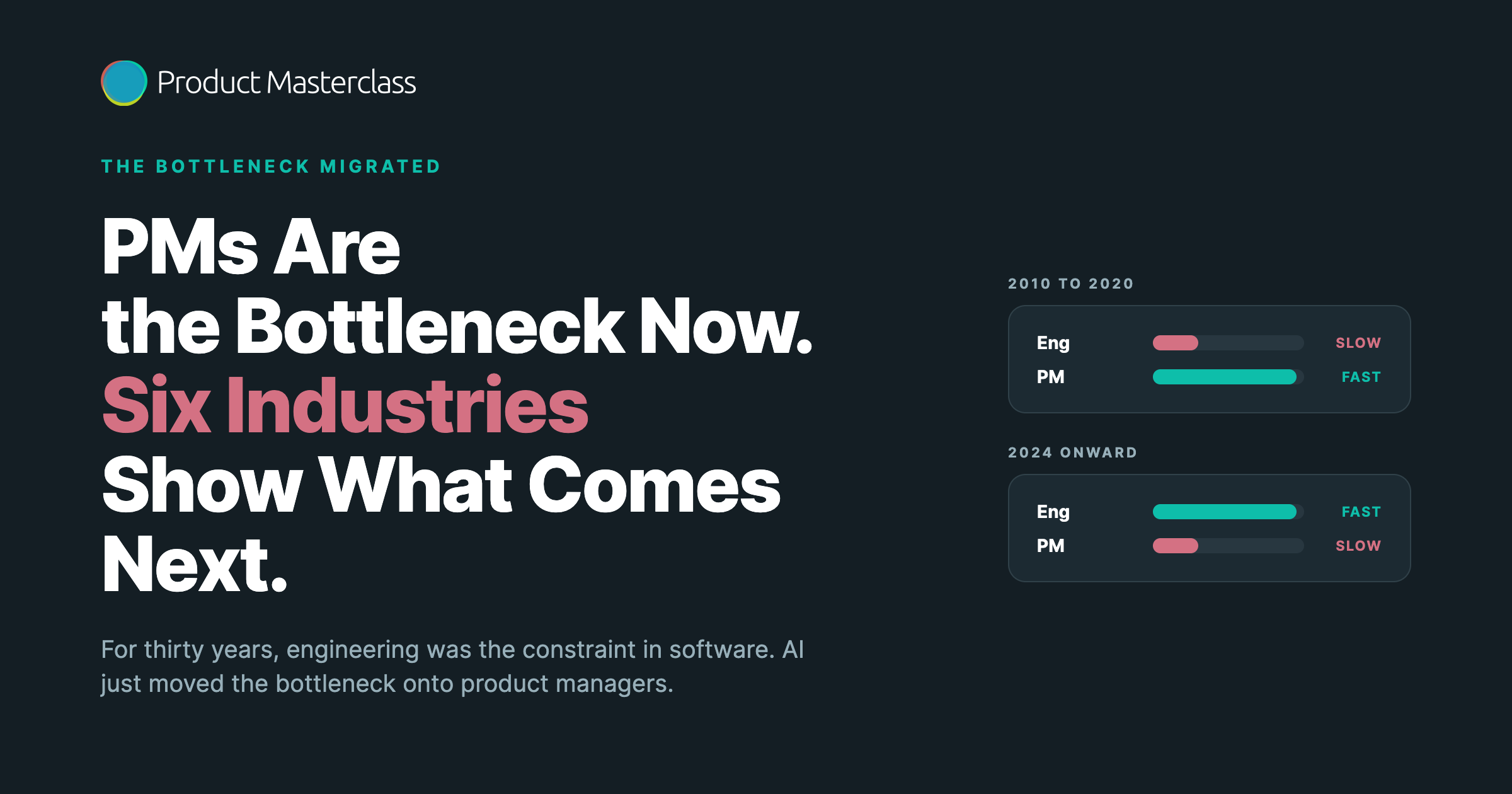
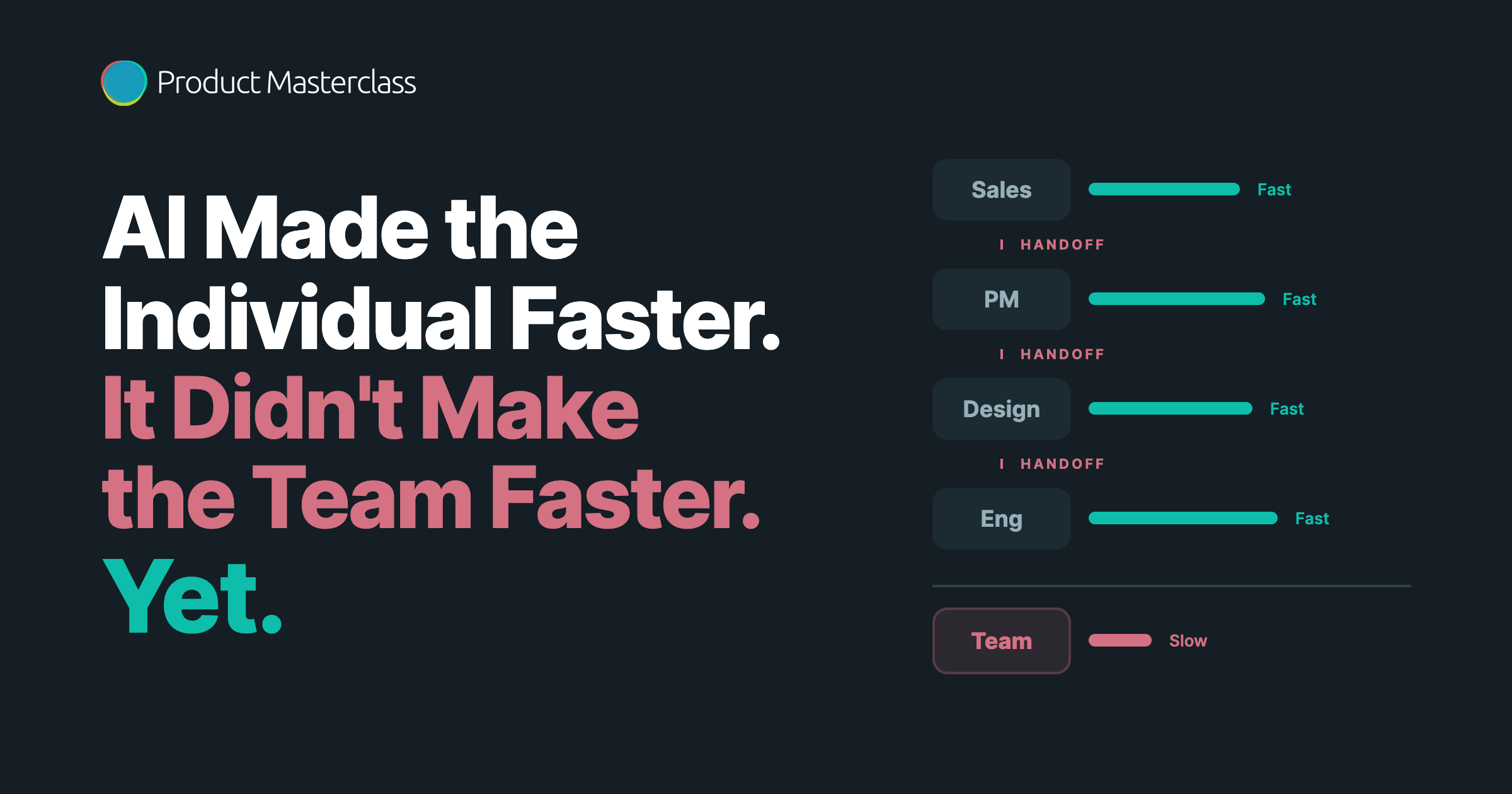
For thirty years, engineering was the constraint in software. AI just moved the bottleneck onto product managers. Most teams will respond by hiring more PMs. They will lose. Here is what six other industries did when they faced the same migration.
Product managers are becoming the bottleneck.
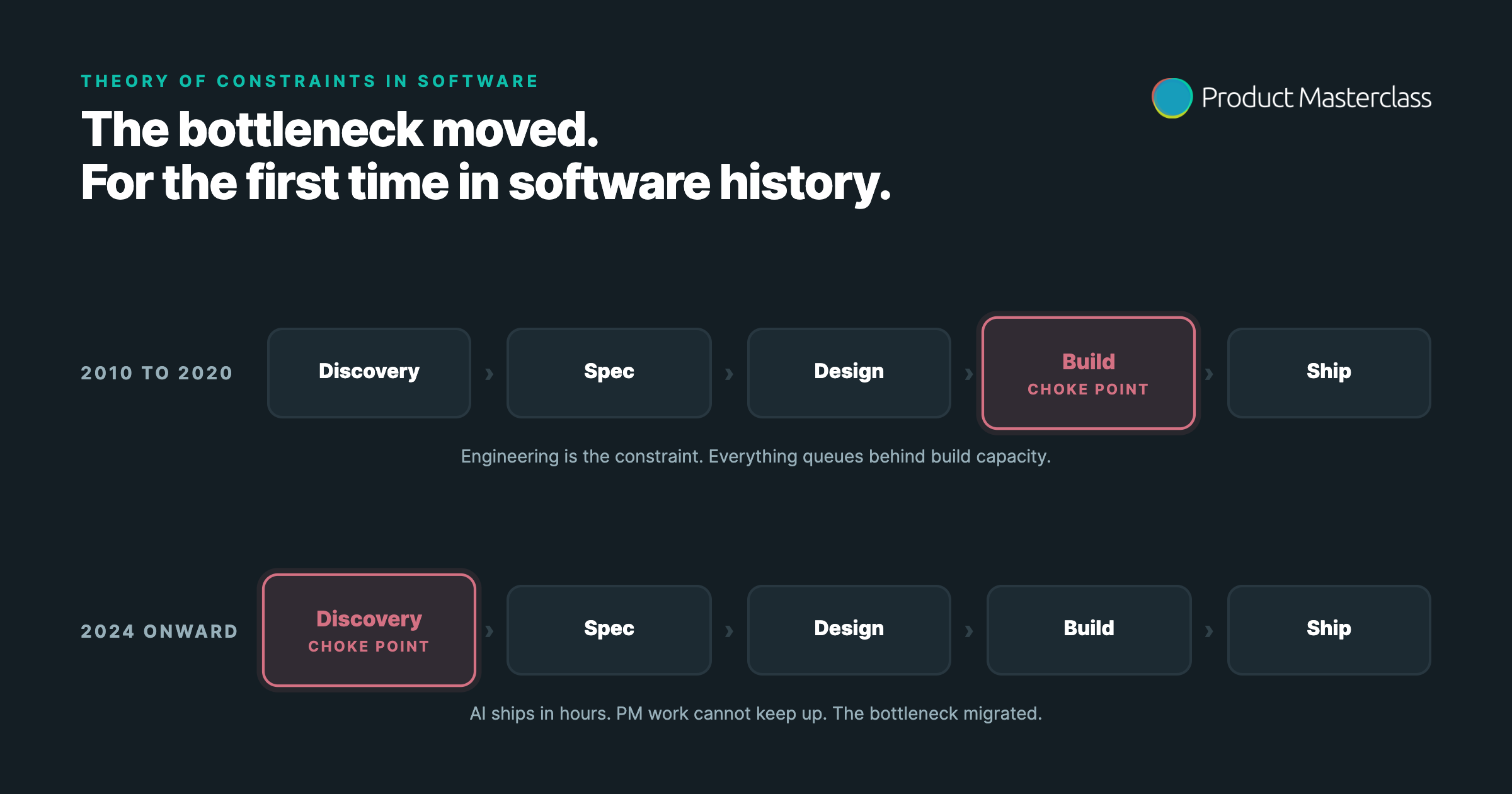
For thirty years, software had one constraint. Engineering. Backlogs were always longer than capacity. PM grew as a discipline, but PM was never the choke point. AI changed that. An engineer with Claude Code ships in hours what used to take weeks. The PM cannot write enough good specs, run enough discovery, or make enough decisions to keep up.
This is the first time the bottleneck in software has actually moved. The cloud era of 2005 to 2015, with CI/CD and open source frameworks and AWS, was bottleneck easing. Engineering got cheaper but stayed the constraint. PM grew alongside, but PM was never scarce. What is happening now is structurally different. The constraint has migrated.
Goldratt named the pattern in 1984. The Theory of Constraints. Solve one constraint, the next one surfaces. The new constraint is rarely solved by doing more of what used to work. It demands a structural response.
Software has never been here before. Other industries have, repeatedly. The history is sharper than we usually admit.
The historical pattern
When a bottleneck migrates, the response is structural, not tactical. Six industries are worth studying. Each one shows a different exit. Each created a multi decade competitive advantage for the companies that picked an exit and committed.
1. Manufacturing. Ford to Toyota.
Henry Ford solved assembly in 1913. Once the line was running, the constraint moved upstream and downstream at once. Materials planning, supplier coordination, design throughput. Ford’s response was vertical integration. The River Rouge plant took iron ore in one end and produced finished cars at the other.
Toyota took a different path forty years later. When their production line matched Ford’s efficiency, planning became their bottleneck. They did not hire more planners. They pushed decision authority down to the line worker. Andon cord, kaizen, kanban. The line worker could stop production. The line worker proposed improvements. The line worker pulled the next batch.
This was the most important move in twentieth century manufacturing because it rejected the obvious answer. Don’t add specialists. Redesign the system so the specialist isn’t needed.
2. Publishing. PageMaker and the death of typesetting.
Aldus PageMaker shipped in 1985. Within a decade, typesetting as a profession was effectively gone. The bottleneck, which had been physical typesetting and plate layout, moved to editorial judgment and curation. There was suddenly more work being produced than any editor could meaningfully assess.
The industry split into two responses. Legacy publishers tightened editorial gatekeeping. The New York Times, The Economist, Penguin Random House. Curation as the value proposition. The web took the other path. Zero gatekeeping plus algorithmic ranking. Google, then Facebook, then TikTok. Both responses worked. Both are still fighting.
The lesson: when the bottleneck is curation, you either become the best curator or build the system that makes curation unnecessary. You cannot stay in the middle.
3. Music. Streaming and the collapse of production cost.
Through the 1990s, the music industry’s bottleneck was production and distribution. Studio time was expensive. Pressing CDs and getting them to retail was expensive. Labels were the gatekeepers because the gate was real.
By 2010, both costs had collapsed. Production became cheap (laptops). Distribution became free (Spotify, YouTube). The bottleneck moved to discovery and attention.
Labels that thought they were in the production business died. Labels that realized they were now in the marketing and playlist business survived, but the inside of those labels looked nothing like before. A&R was rewired around streaming data. Marketing absorbed what used to be label craft. The role of “executive at a label” reinvented itself fundamentally.
4. Finance. Algorithmic trading and the empty floor.
In 1995, the New York Stock Exchange floor employed thousands. Specialists, market makers, runners. Execution was the constraint. By 2010, execution was effectively free. Algorithms did it in microseconds.
The bottleneck moved to alpha generation. The skill of finding an edge that had not yet been priced in. Floor traders did not retrain into quants. The role disappeared. A different role, with different people, took its place. Quant researchers from physics, math, and computer science.
This is the harshest historical case. When a bottleneck migrates far enough, the previously constrained role does not transition. It is replaced. Most floor traders did not become quants. The industry restructured around different humans.
5. Advertising. Programmatic and the rise of strategy.
Through the 2000s, ad agencies organized around media buying. Knowing which TV slots, which billboards, which print runs. Programmatic ad buying automated this layer almost entirely between 2005 and 2015. The agency bottleneck moved to creative and strategy.
Agencies that kept treating media buying as the core function shrank or died. Agencies that restructured around strategists survived. The “creative director” role got elevated. Strategy practices like Wieden and Kennedy and Mother London became the model. Tooling followed. Figma for the production layer. AI copy tools for first drafts.
6. Architecture. CAD and the drafting board.
Through the 1970s, architectural drafting was a real bottleneck. Senior architects had ideas faster than draftsmen could draw them. AutoCAD shipped in 1982. Within a decade, drafting as a separate profession was gone.
Architects did not split into “drafting architects” and “design architects.” They reinvented up the stack. Parametric design (Frank Gehry, Zaha Hadid). Computational design (Foster + Partners). Experience and systems thinking. The role moved upward into questions a draftsman never asked. Where does light fall in winter. How does the building respond to wind. What happens to the user’s experience across the seasons.
The role got bigger by reaching into territory that had been impossible to consider when the drafting board was the bottleneck.
Six exits from the bottleneck
Across these histories, the responses cluster into six patterns. Each is a different exit. Each commits the organization to a different shape.
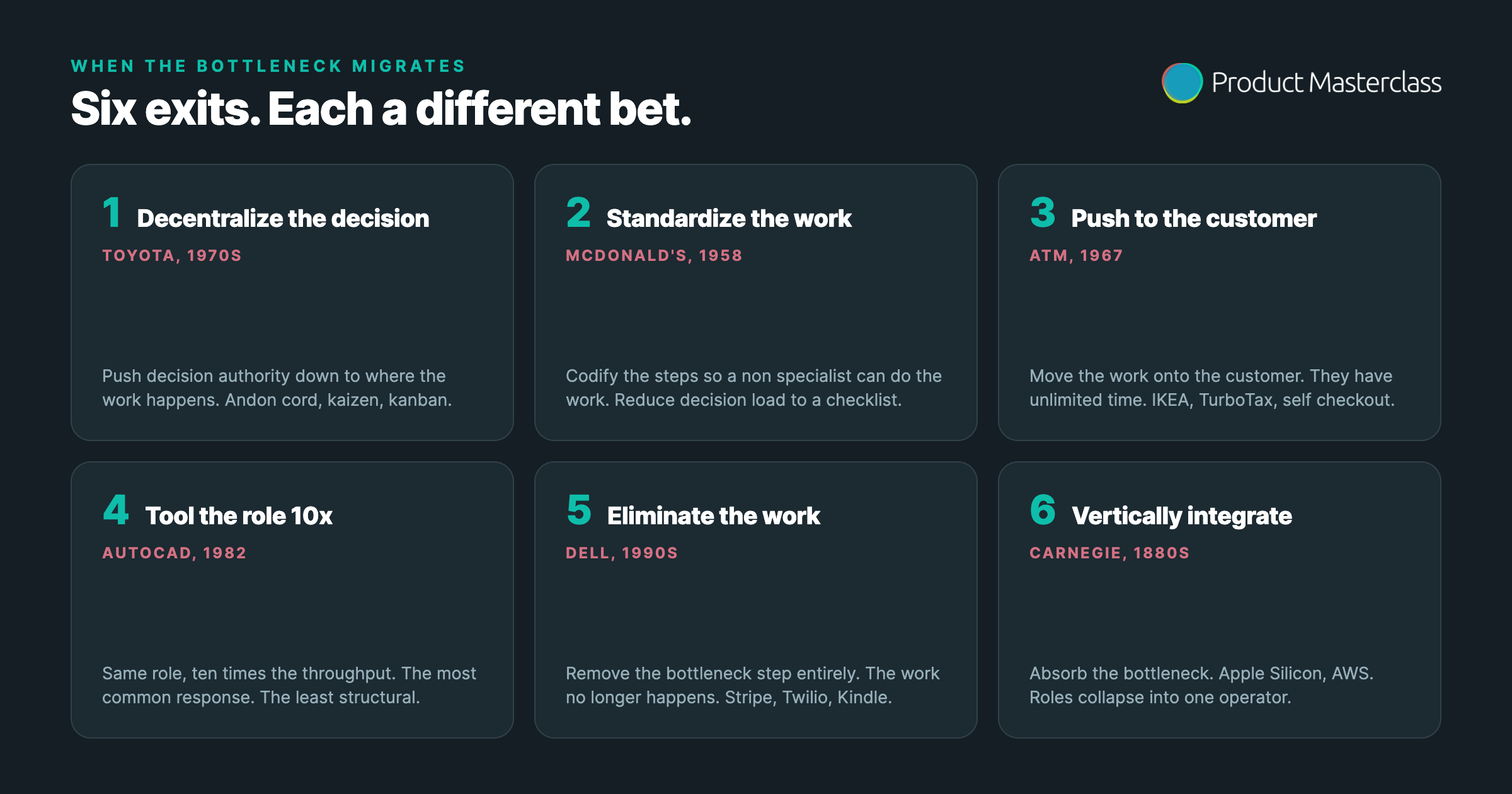
Decentralize the decision. Toyota’s move. Push authority to where the work happens. The U.S. Marine Corps’ “commander’s intent” works the same way. So does W.L. Gore with no managers, and Wikipedia replacing Britannica’s editorial bottleneck with volunteer rules.
Standardize so a non specialist can do it. McDonald’s 1958 Operations Manual codified every step. Manager judgment became a checklist. Six Sigma at Motorola in 1986 did the same for manufacturing variance. Building codes did the same for construction safety.
Push the work to the customer. ATMs in 1967 moved teller work onto the customer. IKEA flat pack moved assembly. TurboTax moved tax prep. Self checkout moved cashier work. The customer has unlimited time.
Tool the bottleneck role 10x. AutoCAD in 1982. VisiCalc and Excel in 1979 and 1985. Photoshop in 1990. Same role, ten times the throughput. The most common response. The least structurally interesting.
Eliminate the bottleneck step entirely. Dell direct to consumer killed retail. Kindle killed printing for books. Stripe killed merchant onboarding. Twilio killed telecom integration. Not “do the work faster.” The work no longer happens because the system doesn’t need it.
Vertical integration. Absorb the bottleneck. Carnegie Steel bought the iron mines and the railways in the 1880s. Apple Silicon absorbed the chip supply bottleneck in 2020. AWS absorbed Amazon’s internal server provisioning bottleneck and turned it into a product line.
Each exit is a different bet. Each requires a different organization. The mistake is to assume there is a default. There is no default. The organizations that won in each historical case picked one and committed.
What this means for PMs, engineers, and designers
Each exit shifts the work, but it also shifts the shape of every role on the team. Here is what each one demands.
Under decentralization (Toyota), engineers and designers absorb product judgment. They make build or no build calls. They own customer context. The PM loses prioritization authority and becomes a coach, holding strategy and standards but no veto. Discovery becomes a team sport, not a PM specialty.
Under standardization (McDonald’s), the PM authors the playbooks. Discovery templates, decision rubrics, JTBD frameworks. Engineers and designers run themselves through those rubrics without waiting for a PM to interpret. The PM moves from operator to system author.
Under push to the customer (ATM), engineers and designers build the feedback machine. In product surveys, AI summarized interviews, analytics that surface needs without PM mediation. The PM becomes the curator of what the system surfaces, not the interpreter of every signal.
Under tooling the bottleneck (AutoCAD), all three roles get faster but none of them change shape. PMs get AI assistants for spec writing and discovery synthesis. Engineers get Claude Code. Designers get AI design assistants. The team ships more, structurally identical to today. The least interesting bet.
Under eliminating the work (Dell), entire categories of role defining work disappear. Status reports, ticket grooming, sprint planning, roadmap formatting. Engineers stop attending product ceremonies. Designers stop polishing mocks for handoff. PMs stop translating between functions. The freed time gets reinvested up the stack into evaluation, taste, and direction.
Under vertical integration (Carnegie), the three roles collapse. The PM, the engineer, and the designer become one operator who owns the full slice. Already the default in early stage AI startups. Possibly the default for new product orgs in the next five years. The boundary between roles dissolves entirely.
The pattern across all six: every exit reshapes engineers and designers as much as it reshapes PMs. A PM exit that does not change what engineers and designers do is not a real exit. It is just better tooling.
The role itself: reinvent up, don’t split
Inside any of these six exits, there is still a question. What does the previously bottlenecked role become?
Two answers dominate the current conversation:
- Tool the PM harder. Better software, AI assistants, the eventual Cursor for product. Preserves the role unchanged.
- Remove the PM entirely. Engineers and AI handle everything from discovery to delivery. Deletes the role.
Both are tactical answers to a structural problem. The structural answer is to reinvent the role up the stack.
History is consistent on this point. When the bottleneck moves off a function, the surviving version of that role moves UP the abstraction stack. Not sideways into sub specialties. Not out of existence.
Architects after CAD reinvented up. Parametric, experience, systems. Editors after desktop publishing moved up into acquisition and curation. Pilots after autopilot reinvented as systems managers and exception handlers, not “takeoff pilots” and “landing pilots.” Toyota line workers absorbed what used to be lower management.
Tooling preserves the verbs. Removal assumes the verbs were never load bearing. Reinventing changes the verbs.
The reinvented PM is probably defined by verbs the old PM never owned:
- Evaluate. Define what good means and prove it. Less “writes specs.”
- Curate. Choose what makes it through. Less “manages backlog.”
- Compress. Strip work the system does not need.
- Design systems. Build the AI workflow that produces the backlog.
- Hold customer truth. Be the source, not the interpreter.
The bet for product organizations
Most product organizations are sleepwalking into one exit. Tool the bottleneck. Better PM software, AI assistants, the eventual Cursor for product. This is the easiest move and the smallest leverage. The role stays the same shape. Output goes up modestly. Nothing structural changes.
It becomes interesting when you combine tooling with one of the other four:
- Decentralize the decision. Engineers and designers make product calls. PM is coach, not gatekeeper.
- Eliminate the work. Status reports, ticket grooming, sprint planning stop existing because the system does not need them.
- Vertically integrate. The founder, PM, engineer roles collapse into one operator. Already the dominant mode in early stage AI startups.
- Reinvent the role upward. PM as evaluator, curator, system designer, holder of customer truth.
The historical winners did not hire more of the bottleneck role. They re architected what the role was for. Toyota did not add planners. They redesigned planning. The newspaper survivors did not hire more editors. They redefined what editing was. The agencies that lived through programmatic did not hire more media buyers. They restructured around strategists.
Better tools and fewer humans are both shortcuts. The real work is to redesign what the role is for.
At Product Masterclass, we train product managers to work effectively in the AI era. Our 8 week intensive program covers everything from customer interviews to vibe coding to building your personal AI workflow. Check out the next cohorts
Discover where product management is heading
Stay up to date with our Product Newsletter and do not miss out on free articles, videos, templates, events on Product Management