Take your team to the next level
Request additional information for an Inhouse Cohort



Like our articles?
If you like our free articles, why stop there?
Take the next step in your career with the Product Masterclass — the 8-week program that turns you into an AI-native product manager.
Cloud AI Is the Mainframe. Apple Silicon Is the Personal Computer.
The biggest bet in tech isn't about who builds the best AI model. It's about where intelligence lives. Cloud AI providers are spending $690 billion on centralized infrastructure. Apple is spending $13 billion on silicon that could make most of it unnecessary. We've seen this movie before.
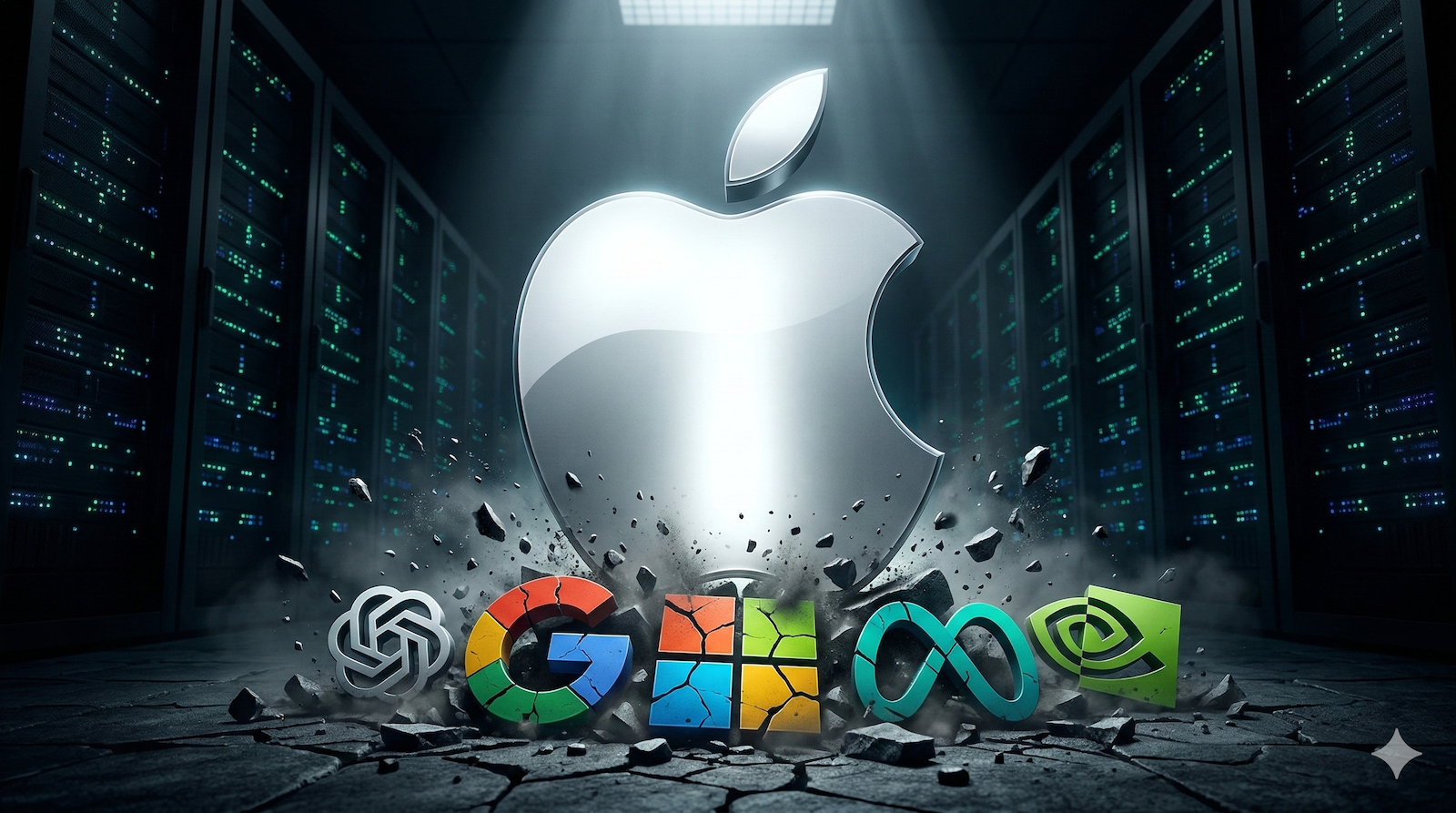
Cloud AI Is the Mainframe. Apple Silicon Is the Personal Computer.
The biggest bet in tech right now isn't about who builds the best AI model. It's about where intelligence lives. And we've seen this movie before.
In 1964, IBM launched the System/360 - a $5 billion gamble on a family of mainframe computers that would dominate the industry for two decades. Centralized. Powerful. Expensive. By 1970, IBM controlled over 70% of the computer market [1]. The remaining competitors were so outmatched they earned the nickname "the Seven Dwarfs."
Then something happened that nobody at IBM took seriously. Small, cheap, "toy" computers started showing up on desks. They couldn't run airline reservation systems. They couldn't process millions of banking transactions. But they could run spreadsheets. And word processors. And that turned out to be enough.
Within 15 years, the personal computer had dismantled IBM's empire. Not by being more powerful - but by being everywhere.
I think we're watching the exact same pattern unfold in artificial intelligence. And most people are looking at it backwards.
The Mainframes of AI
Let's start with what everyone can see.
OpenAI, Google, Anthropic, Microsoft, Meta - these companies are building the mainframes of the AI era. Centralized systems of extraordinary power, running on massive GPU clusters in data centers that consume as much electricity as small cities. The numbers are staggering.
The five largest hyperscalers - Amazon, Microsoft, Google, Meta, and Oracle - have committed to spending between $660 billion and $690 billion on capital expenditure in 2026 alone [2]. That's roughly 75% directed at AI infrastructure [3]. OpenAI has announced approximately $1 trillion in AI infrastructure deals [4]. The Stargate project plans $500 billion over four years.
These are mainframe-scale numbers. Centralized. Capital-intensive. Dependent on economies of scale that only a handful of organizations can afford. Sound familiar?
IBM's mainframe customers in the 1970s accessed computing through terminals connected to a central machine. Today's AI users access intelligence through browsers and APIs connected to central data centers. The architecture is remarkably similar - a powerful central brain, dumb endpoints, and a network in between.
And just like the mainframe era, the centralized model works beautifully for its intended purpose. GPT-5, Claude, Gemini - these models are extraordinary. They can reason, write, code, and analyze at levels that seemed impossible five years ago. For complex tasks that require frontier-level intelligence, cloud AI will remain essential for a long time.
But here's the thing about mainframes. They also remained essential for a long time. Many are still running today [5], processing banking transactions and airline reservations. IBM still sells them. The mainframe didn't die.
It just became irrelevant for 95% of what people actually needed computers to do.
The personal computer pattern
The mainframe-to-PC transition followed a specific pattern that Clayton Christensen later codified as "disruptive innovation" in his landmark 1997 book The Innovator's Dilemma [6]. Understanding this pattern is key to understanding what's happening in AI right now.
Phase 1: The centralized pioneer creates the market. IBM's mainframes proved that computers could transform business. They were expensive, required specialized operators, and lived in dedicated rooms. But they demonstrated the value of computation itself. Without mainframes, nobody would have known what computers were for.
Phase 2: The technology gets "good enough" for smaller form factors. As processors got cheaper and more efficient, it became possible to put a computer on a desk. The Apple II (1977), the IBM PC (1981) [7], and their clones weren't as powerful as mainframes. But they were powerful enough for the tasks that individual workers needed: writing documents, running calculations, managing data.
Phase 3: Distribution and accessibility beat raw power. By the mid-1980s, there were millions of PCs and only thousands of mainframes. The economics flipped. Software developers built for PCs because that's where the users were. Networks connected PCs together, giving them capabilities that approached mainframe territory. The "good enough" threshold kept rising until PCs could handle nearly everything.
Phase 4: The value migrates. IBM's mistake wasn't entering the PC market - they actually built the IBM PC. Their mistake was using off-the-shelf components and licensing Microsoft's operating system rather than building proprietary systems. IBM legitimized the PC, then watched the value migrate [8] from hardware (where IBM had the advantage) to software (where Microsoft captured it) and processors (where Intel captured it). By 1993, IBM posted an $8.2 billion loss [9] - then the largest in U.S. corporate history.
The PC didn't win by being better than the mainframe. It won by being everywhere - on every desk, in every home, personal and accessible. Power moved from centralized to distributed. From institutional to individual. From the data center to the desktop.
Now map this onto AI
The parallels are almost too clean.
Today's cloud AI services are the mainframes. ChatGPT, Claude, Gemini - they're centralized, powerful, expensive to operate, and controlled by a handful of companies. You access them through a terminal (your browser) connected to a central machine (a GPU cluster in a data center). The AI companies building these systems are spending mainframe-scale money - hundreds of billions annually [10] - on centralized infrastructure.
On-device AI is the personal computer. Models running locally on your phone, laptop, or tablet. Smaller, less powerful than the cloud models. But personal. Private. Always available. And getting better at an exponential rate.
And here's where Apple enters the picture.
Apple Silicon: the chip designed for AI's PC moment
While the rest of big tech has been racing to build bigger data centers, Apple has been quietly building something different: the most advanced consumer AI silicon in the world.
The trajectory tells the story:
Apple's Neural Engine - the dedicated AI processor built into every Apple chip - has been on an exponential improvement curve [11]. The M1 (2020) delivered 11 trillion operations per second (TOPS). The M4 (2024) hit 38 TOPS [12] - more than triple. And the M5, announced in late 2025, leaps to roughly 133 TOPS [13] - a 12x improvement over M1 in just five years.
A quick explainer on TOPS: it stands for Trillion Operations Per Second and measures how many AI-specific calculations a chip can perform. It's the key metric for the Neural Engine - the part of the chip purpose-built for machine learning. To put Apple's trajectory in perspective: the M1's 11 TOPS in 2020 was impressive for a laptop chip. The M5's 133 TOPS five years later approaches the performance of a single server-grade GPU like Nvidia's H100 - but in a fanless laptop running on battery power.
But raw TOPS isn't even the most important number. The M5 introduced something architecturally novel [14]: Neural Accelerators inside each GPU core, allowing AI workloads to run across the entire chip rather than being bottlenecked through a single engine. Apps like LM Studio can now run large language models locally on a MacBook. The M5 delivers over 4x the peak GPU compute for AI workloads compared to M4.
And this is just the base M5 chip. Projections for the M5 Ultra suggest it could reach 600-800 TOPS - approaching the performance of a single data center GPU, but on a desktop, silent, and drawing a fraction of the power.
Meanwhile, on the iPhone side, the A18 Pro already runs Apple's on-device language model at 30 tokens per second with a first-token latency of just 0.6 milliseconds [15]. That's faster than most cloud API calls, because there's no network round-trip.
Apple's unified memory architecture is the other crucial piece. Unlike traditional PCs where the CPU and GPU have separate memory pools, Apple Silicon gives the Neural Engine, GPU, and CPU shared access to fast memory - up to 128 GB on M4 Max with over 500 GB/s bandwidth [16]. This matters enormously for AI, because running language models is fundamentally a memory-bandwidth problem [17]: every token requires streaming the full model weights through memory.
This isn't an accident. Apple has been designing silicon specifically for on-device AI for years. The Neural Engine first appeared in the A11 Bionic in 2017 [18] - before ChatGPT existed. Apple wasn't reacting to the AI race. They were building the infrastructure for it.
Why Apple doesn't need to build data centers
At this point, an obvious question comes up: If Apple Silicon is so power-efficient and capable for AI workloads, why doesn't Apple just build servers for data centers and compete with Nvidia?
The short answer: Apple doesn't need to win the data center. It needs to make the data center unnecessary - at least for the part of the market Apple cares about.
To understand why, you need to understand the difference between two fundamentally different AI workloads: training and inference.
Training is teaching a model. It's the process where companies like OpenAI feed trillions of tokens of text into a neural network and adjust billions of parameters over weeks or months. This requires insane amounts of parallel computation - thousands of GPUs working together simultaneously on a single massive task. That's what the $690 billion in data center spending is largely paying for. Nvidia dominates here because their architecture is built for exactly this: massive parallelization across thousands of GPUs in a cluster.
Inference is using a trained model. It's what happens when you ask ChatGPT a question or when Siri summarizes your notifications. You take a finished model, feed it an input, and get an output. This is a fundamentally different computational problem. It doesn't require thousands of GPUs working in concert. It requires efficiently running a single model, ideally as fast and cheaply as possible.
Apple Silicon is not designed for training. It's designed for inference. The unified memory architecture - where CPU, GPU, and Neural Engine share the same memory pool - is perfect for loading a model into memory once and running it efficiently for one user on one device. Nvidia's architecture is designed for a completely different problem: thousands of users, one giant cluster, massive models being trained or served simultaneously.
This distinction is the heart of the mainframe analogy. Mainframes were built for centralized, industrial-scale workloads. PCs were built for individual, personal workloads. Both are "computers" - but optimized for entirely different jobs. Cloud AI infrastructure is the mainframe: built for training and large-scale inference serving. Apple Silicon is the PC: built for personal, on-device inference.
And here's why this matters strategically: the AI industry is shifting from training to inference [19]. Deloitte estimates that inference already accounts for two-thirds of all AI compute in 2026, up from a third in 2023. As more models get trained and deployed, the ratio will keep tilting toward inference. And if a growing share of that inference happens on-device rather than in the cloud - on Apple Silicon rather than Nvidia GPUs - then Apple captures the largest and fastest-growing segment of AI compute without building a single data center.
Apple actually does run its own Apple Silicon servers already - a system called Private Cloud Compute [20]. When your iPhone encounters an AI task too complex for on-device processing, it routes to Apple-designed servers running Apple chips, with end-to-end encryption and stateless computation. But this isn't a data center business. It's a safety net for the cases where on-device isn't enough yet - and that safety net shrinks every time Apple ships a more powerful chip.
The PC didn't win by building a better mainframe. It won by making the mainframe unnecessary for most people. Apple's bet is the same: don't build a better data center. Build a chip so good that most consumers don't need one.
The "good enough" line is moving fast
The most important question in any disruption story is: when does the inferior technology become "good enough" for mainstream use?
For on-device AI, that threshold is moving faster than almost anyone expected.
In 2023, running a language model on a phone was a novelty - slow, limited, barely useful. By 2025, the landscape had transformed. Sub-billion-parameter models can now handle many practical tasks [21]: text summarization, writing assistance, code completion, photo editing, translation. Research shows that small models trained with high-quality data and distilled from larger models can outperform base models many times their size on reasoning benchmarks.
At WWDC 2025, Apple released its Foundation Models framework [22], giving developers free access to an approximately 3-billion-parameter on-device model with as few as three lines of Swift code. Inference costs: zero. Network requirement: none. Privacy: complete. This is Apple's equivalent of the open PC architecture - but with Apple maintaining platform control.
The research community confirms the trajectory. A January 2025 paper found that hybrid edge-cloud approaches can deliver energy savings of up to 75% and cost reductions exceeding 80% [23] compared to pure cloud processing. Deloitte projects [19] that by 2026, inference workloads will account for roughly two-thirds of all AI compute, up from a third in 2023. And the trend is unmistakable: more of that inference is moving to the edge [24].
The trade-off is clear and well understood. Frontier reasoning - the kind of deep, multi-step analysis that GPT-5 and Claude excel at - still requires cloud-scale compute. But daily utility tasks like formatting text, answering quick questions, summarizing notifications, editing photos, running personal assistants? On-device models are already good enough. And "good enough" on your own device, private and instant, beats "better" in a distant data center for most consumer use cases.
That's exactly what happened with PCs versus mainframes. The PC was never better than the mainframe at what mainframes did best. But it was vastly better at what most people actually needed.
Apple's distribution moat: 2.5 billion devices
Here's where the mainframe-to-PC analogy gets really interesting.
IBM controlled 70% of the mainframe market. But there were only thousands of mainframes in the world. The PC market quickly grew to millions, then hundreds of millions of units. The sheer number of PCs meant that's where software developers built, which attracted more users, which attracted more developers. The flywheel effect crushed the mainframe's advantages.
Apple has 2.5 billion active devices [25] - iPhones, iPads, Macs, Apple Watches, Apple Vision Pro. Every one of them has a Neural Engine. That's the largest single distribution channel for AI hardware in history. And an estimated 70% of the active iPhone base can't yet run Apple Intelligence, creating a massive potential upgrade cycle.
When Apple ships an AI feature, it doesn't launch to a few million early adopters. It launches to billions of devices simultaneously. No cloud AI provider can match this distribution. ChatGPT has roughly 200 million monthly active users. Meta AI claims over 1 billion [26]. But these users access AI through apps and browsers - they don't own AI-capable hardware that runs inference locally.
Apple's play is to make every device in its ecosystem an AI-capable computer. Not a terminal connected to a centralized brain - but a genuinely intelligent device that happens to call the cloud when it needs to.
The $690 billion question
Let's zoom out and look at the economics.
The hyperscalers - Amazon, Microsoft, Google, Meta, Oracle - plan to spend roughly $690 billion on infrastructure in 2026 [2]. OpenAI alone has announced approximately $1 trillion in infrastructure deals [4]. These are mainframe-scale investments in centralized computing.
Apple's AI capex? Roughly $13 billion [27]. Less than 2% of what the hyperscalers are spending.
The bears see this as evidence that Apple is losing the AI race. But what if Apple isn't playing the same game?
In the mainframe era, IBM spent enormous sums on centralized infrastructure. But the value eventually migrated to the distributed layer - PCs, their operating systems, and the software that ran on them. The companies that spent the most on mainframe technology didn't win the next era. The companies that put computing power in people's hands did.
Apple is making a bet - whether consciously or by default - that the same thing will happen with AI. The cloud AI giants will spend trillions building centralized infrastructure. And Apple will harvest the value at the edge, running increasingly capable models on 2.5 billion devices, with zero marginal inference cost, complete privacy, and instant response times.
If AI models continue to commoditize - and API pricing has dropped 97% since GPT-3 [28] - then building the world's best AI hardware platform may prove far more valuable than building the world's best AI model.
Where the analogy breaks down
To be intellectually honest, we need to acknowledge where this framing doesn't hold.
On-device AI might not get good enough fast enough. The mainframe-to-PC transition took 15 years. The smartphone revolution took about 5. AI moves even faster - but the gap between on-device and cloud models is still enormous for complex reasoning tasks. If the next wave of AI value comes from agentic workflows and deep reasoning - tasks that require frontier-scale models - then on-device AI might remain a complement to the cloud rather than a replacement.
Apple's execution has been genuinely poor. The Siri overhaul, previewed at WWDC 2024, was supposed to be revolutionary. It shipped 21 months late with a reported one-third failure rate [29] in internal testing. Apple's head of AI, John Giannandrea, stepped down in December 2025 [30] after what Bloomberg described as a "tumultuous tenure." At least twelve top AI researchers have left, many to Meta [31]. Apple Intelligence notification summaries generated fabricated headlines [32] that triggered lawsuits [33]. John Gruber gave Apple Intelligence an "F" for 2025 [34]. This isn't the behavior of a company executing a brilliant long-term strategy. It looks more like organizational dysfunction.
Apple doesn't control the frontier models. IBM's weakness in the PC era was that it didn't control the operating system (Microsoft) or the processor (Intel). Apple's potential weakness in the AI era is that it doesn't control the frontier models. It's partnering with OpenAI [35], Google [36], and (nearly) Anthropic [37]. If one of these partners achieves lasting dominance - becoming the "Microsoft" of AI - Apple's role as a mere distribution channel could leave it capturing less value than the model provider.
Consumer behavior might change. The entire on-device thesis assumes that consumers will continue to do most of their AI interactions through their existing devices. But what if AI assistants, smart glasses, or entirely new form factors emerge that bypass the iPhone? Eddy Cue, Apple's SVP of Services, admitted in court testimony [38]: "You may not need an iPhone 10 years from now."
These are real risks, and they shouldn't be dismissed. IBM's fall wasn't inevitable - it was the result of specific decisions (open architecture, outsourced OS) that an incumbent with IBM's resources could have avoided. Apple's current struggles suggest the company is capable of similar mistakes.
What this means for product leaders
Whether you're building products at a startup or leading a product team at an enterprise, the mainframe-to-AI transition offers six strategic lessons.
1. Watch where computing moves, not where it sits today.
The most common mistake during a platform transition is optimizing for the current architecture. In the late 1970s, every rational analysis said mainframes were superior. They were. But computing was moving from centralized to distributed. Today, every rational analysis says cloud AI models are superior. They are. But AI compute is moving from the cloud to the edge [24]. Product leaders should ask: Where will AI inference happen in three years? and build for that world.
2. "Good enough" is the most dangerous phrase in strategy.
When on-device models are "good enough" for your users' actual daily tasks - not their theoretical maximum needs - cloud AI loses its advantage for those use cases. Map your users' AI needs onto a spectrum from "requires frontier reasoning" to "needs fast, private, basic intelligence." If most of your use cases cluster toward the second end, on-device is your future. Track the "good enough" line [6] obsessively - it moves faster than you think.
3. Distribution beats capability in consumer markets.
IBM built the best mainframes. They lost anyway. Ben Thompson has argued persuasively [39] that Christensen's disruption framework applies most reliably to B2B markets - but in consumer markets, user experience can't be "overshot." The lesson: if you're building AI-powered products, reaching 100 million users with a "good enough" on-device experience may be worth more than reaching 1 million users with a state-of-the-art cloud experience. Think about where your users are and how you reach them.
4. The value layer shifts during transitions.
In mainframes, value was in integrated hardware-software. In PCs, value migrated to the OS and processor layers. A Harvard Business School paper [40] documented this "vertical-to-horizontal" transition in detail. In cloud AI, value is currently in model creation. But as models commoditize, value will migrate to the distribution, trust, and user-experience layers. Product leaders should honestly assess: Where will value accumulate in the AI stack in 3-5 years? Build there, not where value sits today.
5. On-device inference changes AI product economics back to SaaS.
This might be the most practical insight for product managers building AI-powered products today.
When your product runs AI inference in the cloud, you pay for every API call. Every user query costs you money. The more successful your product, the higher your inference bill. This breaks the traditional SaaS model, where marginal cost per user is near zero. Cloud AI turns software back into a variable-cost business - and many startups are discovering that their unit economics don't work at scale because inference costs eat their margins.
But when AI runs on-device, the user's hardware does the work. Your marginal cost per inference? Zero. Just like traditional SaaS. You ship the model once, the user runs it locally, and your cost structure stays flat regardless of how many queries they make.
If you can design your AI features to run on-device - using Apple's Foundation Models framework, or open-source models via tools like llama.cpp or MLX - you restore SaaS-like economics. Your gross margins stay high. Your pricing can be subscription-based without hidden variable costs eating your business from the inside. And your product works offline, responds instantly, and protects user privacy as a bonus.
The products that figure out how to push as much intelligence as possible to the edge - while only calling the cloud for tasks that genuinely need it - will have a structural cost advantage over competitors that default to cloud-first AI.
6. Time compression means less room for patience.
The mainframe-to-PC transition took 15 years. The smartphone revolution took 5. AI transitions may compress to 2-3 years. Apple's "late but integrated" playbook [41] has historically worked because there was enough time to observe, learn, and execute. With ChatGPT hitting 200+ million monthly active users in just two years, the window for patience is narrower than ever. Whether you're an incumbent protecting existing revenue or a startup trying to disrupt, speed matters more than in any previous technology cycle.
The verdict: Apple is building the PC of AI
Let me be direct about where I come down on this.
The mainstream narrative says Apple is losing the AI race because it doesn't have the best models, it's spending a fraction of what competitors spend, and Siri is embarrassing. All of that is true.
But the mainstream narrative is evaluating Apple as if it's competing to build the best mainframe. It's not.
Apple is competing to build the personal computer of AI - the device that puts intelligence in your pocket, on your desk, and on your wrist. Private. Instant. Personal. Always available. Running on silicon that was designed specifically for this purpose, distributed across 2.5 billion devices that people already own and love.
The cloud AI giants are spending $690 billion building centralized infrastructure [2]. Apple is spending $13 billion building the silicon that makes centralized infrastructure unnecessary for most of what consumers actually do with AI.
History doesn't repeat, but it rhymes. In the 1980s, nobody was ever fired for buying IBM. In the 2020s, nobody is criticized for building on OpenAI. But the companies that put computing power in people's hands - Apple, Microsoft, Intel, and the clone makers - captured the next era.
The question isn't whether Apple will build a better model than GPT-5. It won't. The question is whether a 3-billion-parameter model running instantly and privately on your iPhone will be good enough for 90% of what you actually do with AI every day.
If the answer is yes - and the trajectory strongly suggests it will be [17] - then the $690 billion mainframe era of AI will eventually give way to something more personal, more distributed, and more Apple-shaped.
The biggest winners of the AI era might not be the companies building the biggest models. They might be the ones putting intelligence in every pocket.
At Product Masterclass, we train product managers to work effectively in the AI era. Our 8-week intensive program covers everything from customer interviews to vibe coding to building your personal AI workflow. Check out the next cohort
Sources
[1] "Historical Interlude: From the Mainframe to the Minicomputer - IBM and the Seven Dwarfs," They Create Worlds. https://videogamehistorian.wordpress.com/2014/11/08/historical-interlude-from-the-mainframe-to-the-minicomputer-part-2-ibm-and-the-seven-dwarfs/
[2] "AI Capex 2026: The $690B Infrastructure Sprint," Futurum Group, February 2026. https://futurumgroup.com/insights/ai-capex-2026-the-690b-infrastructure-sprint/
[3] "Hyperscaler capex > $600 bn in 2026," IEEE ComSoc Technology Blog, December 2025. https://techblog.comsoc.org/2025/12/22/hyperscaler-capex-600-bn-in-2026-a-36-increase-over-2025-while-global-spending-on-cloud-infrastructure-services-skyrockets/
[4] "OpenAI's $1 Trillion Infrastructure Spend," Tomasz Tunguz, November 2025. https://tomtunguz.com/openai-hardware-spending-2025-2035
[5] "Betting on the mainframe pays off for IBM," The Irish Times. https://www.irishtimes.com/business/betting-on-the-mainframe-pays-off-for-ibm-1.1137074
[6] The Innovator's Dilemma: When New Technologies Cause Great Firms to Fail, Clayton Christensen, 1997. https://en.wikipedia.org/wiki/The_Innovator%27s_Dilemma
[7] "The IBM PC," IBM History. https://www.ibm.com/history/personal-computer
[8] "How the IBM PC Won, Then Lost, the Personal Computer Market," IEEE Spectrum. https://spectrum.ieee.org/how-the-ibm-pc-won-then-lost-the-personal-computer-market
[9] "How IBM Crashed, Then Rebooted With a $24 Billion Comeback," Leaders.com. https://leaders.com/articles/business/ibm-history/
[10] "Big Tech's $405B Bet: Why AI Stocks Are Set Up for a Strong 2026," IO Fund, November 2025. https://io-fund.com/ai-stocks/ai-platforms/big-techs-405b-bet
[11] "Neural Engine," Apple Wiki. https://apple.fandom.com/wiki/Neural_Engine
[12] "Apple introduces M4 chip," Apple Newsroom, May 2024. https://www.apple.com/newsroom/2024/05/apple-introduces-m4-chip/
[13] "The AI tsunami: Apple's M5 chip delivers a 12x performance leap," TechRadar, October 2025. https://www.techradar.com/pro/the-ai-tsunami-apples-m5-chip-delivers-a-12x-performance-leap-heres-what-the-neural-accelerators-mean-for-your-mac
[14] "Apple unleashes M5, the next big leap in AI performance for Apple silicon," Apple Newsroom, October 2025. https://www.apple.com/newsroom/2025/10/apple-unleashes-m5-the-next-big-leap-in-ai-performance-for-apple-silicon/
[15] "Introducing Apple's On-Device and Server Foundation Models," Apple Machine Learning Research, June 2024. https://machinelearning.apple.com/research/introducing-apple-foundation-models
[16] "Apple introduces M4 Pro and M4 Max," Apple Newsroom, October 2024. https://www.apple.com/newsroom/2024/10/apple-introduces-m4-pro-and-m4-max/
[17] "On-Device LLMs in 2026: What Changed, What Matters, What's Next," Edge AI and Vision Alliance, January 2026. https://www.edge-ai-vision.com/2026/01/on-device-llms-in-2026-what-changed-what-matters-whats-next/
[18] "Neural Engine," Wikipedia. https://en.wikipedia.org/wiki/Neural_Engine
[19] "Why AI's next phase will likely demand more computational power, not less," Deloitte TMT Predictions 2026. https://www.deloitte.com/us/en/insights/industry/technology/technology-media-and-telecom-predictions/2026/compute-power-ai.html
[20] "Private Cloud Compute: A new frontier for AI privacy in the cloud," Apple Security Research. https://security.apple.com/blog/private-cloud-compute/
[21] "On-Device LLMs: State of the Union, 2026," Vikas Chandra, Meta AI Research. https://v-chandra.github.io/on-device-llms/
[22] "Apple supercharges its tools and technologies for developers," Apple Newsroom, June 2025. https://www.apple.com/newsroom/2025/06/apple-supercharges-its-tools-and-technologies-for-developers/
[23] "Edge AI: The future of AI inference is smarter local compute," InfoWorld, January 2026. https://www.infoworld.com/article/4117620/edge-ai-the-future-of-ai-inference-is-smarter-local-compute.html
[24] "2026 AI story: Inference at the edge, not just scale in the cloud," R&D World, December 2025. https://www.rdworldonline.com/2026-ai-story-inference-at-the-edge-not-just-scale-in-the-cloud/
[25] "Apple's 2026 AI Inflection: Quantifying the Growth from 2.5 Billion Devices," Ainvest, February 2026. https://www.ainvest.com/news/apple-2026-ai-inflection-quantifying-growth-2-5-billion-devices-2602/
[26] "15 Most Used Generative AI Chatbots [July 2025 Rankings & Stats]," DarwinApps. https://www.blog.darwinapps.com/blog/15-most-used-generative-ai-chatbots
[27] "Apple appears to be sitting out the AI arms race. Will the strategy work?" CNBC, February 2026. https://www.cnbc.com/2026/02/27/apple-appears-to-be-sitting-out-the-ai-arms-race-will-the-strategy-work.html
[28] "How Apple Is Winning the AI Race - by Staying Out of It," The Motley Fool, February 2026. https://www.fool.com/investing/2026/02/10/why-apple-is-winning-the-ai-race-by-staying-out/
[29] "2025 will be remembered for what Apple didn't deliver," Macworld. https://www.macworld.com/article/3019152/2025-what-apple-didnt-deliver.html
[30] "Apple AI Head John Giannandrea to Leave After Chaotic Stint," Bloomberg, December 2025. https://www.bloomberg.com/news/articles/2025-12-01/apple-artificial-intelligence-head-to-leave-after-ai-struggles
[31] "Inside Tim Cook's push to get Apple back in the AI race," Artificial Intelligence News. https://www.artificialintelligence-news.com/news/inside-tim-cook-push-to-get-apple-back-in-the-ai-race/
[32] "Apple Intelligence errors with news alerts keep piling up," 9to5Mac, January 2025. https://9to5mac.com/2025/01/03/apple-intelligence-errors-with-news-alerts-keep-piling-up/
[33] "Apple sued for false advertising over Apple Intelligence," Axios, March 2025. https://www.axios.com/2025/03/20/apple-suit-false-advertising-ai-intelligence
[34] "My 2025 Apple Report Card," Daring Fireball, February 2026. https://daringfireball.net/2026/02/my_2025_apple_report_card
[35] "OpenAI rolls out ChatGPT for iPhone in landmark AI integration with Apple," VentureBeat. https://venturebeat.com/ai/openai-rolls-out-chatgpt-for-iphone-in-landmark-ai-integration-with-apple
[36] "The Apple-Google AI Deal: What $1 Billion Says About Who's Really Winning the AI Race," Security Boulevard, February 2026. https://securityboulevard.com/2026/02/the-apple-google-ai-deal-what-1-billion-says-about-whos-really-winning-the-ai-race/
[37] "Apple could have used Claude to power a future Siri, but Anthropic got greedy," AppleInsider, January 2026. https://appleinsider.com/articles/26/01/30/apple-could-have-used-claude-to-power-a-future-siri-but-anthropic-got-greedy
[38] "Apple is facing pressure from Wall Street to figure out its AI strategy," CNBC, July 2025. https://www.cnbc.com/2025/07/30/apple-ai-hardware-devices.html
[39] "What Clayton Christensen Got Wrong," Stratechery by Ben Thompson, 2013. https://stratechery.com/2013/clayton-christensen-got-wrong/
[40] "Explaining the Vertical-to-Horizontal Transition in the Computer Industry," Harvard Business School Working Paper. https://www.hbs.edu/ris/Publication%20Files/17-084_008a9781-260b-41e1-9d78-4872817eb71f.pdf
[41] "Apple and the late-mover advantage," Mobile World Live. https://www.mobileworldlive.com/latest-stories/apple-and-the-late-mover-advantage/
Discover where product management is heading
Stay up to date with our Product Newsletter and do not miss out on free articles, videos, templates, events on Product Management