Take your team to the next level
Request additional information for an Inhouse Cohort



Like our articles?

If you like our free articles, why stop there?
Take the next step in your career with the Product Masterclass — the 8-week program that turns you into an AI-native product manager.
When Code is Cheap, Product Thinking Becomes the New Bottleneck
For 30 years, software engineers were the constraint in every software organisation. AI is changing that. Here's what comes next - and why most companies aren't ready.
A Book I Read at Business School - That I Still Think About Today
During my MBA in San Francisco, we had to read a book called The Goal by Eliyahu Goldratt. I'll be honest - when I saw it was a business novel set in a manufacturing plant, I wasn't exactly excited.
But one story in that book has stayed with me ever since.
The protagonist, Alex, leads a Boy Scout hiking trip. The troop sets off in a single-file line. Within minutes, the group starts to stretch apart. The fast kids sprint ahead. The slow ones fall behind. By the time they stop for a break, there's half a mile of trail between the front and the back.
Alex has an insight: it doesn't matter how fast the fastest kid walks. The group can only move as fast as its slowest member - a kid named Herbie, carrying a backpack stuffed with camping gear.
So Alex makes a simple change. He puts Herbie at the front. He distributes Herbie's heavy load across the rest of the troop. And just like that, the group moves together. Throughput increases.
The real lesson wasn't about hiking. It was this: every system has a bottleneck - a single constraint that limits the output of the entire organisation. Your job is to find it, optimise it, and when it's resolved, find the next one.
That idea has shaped how I think about organisations ever since.
For 30 Years, the Developer Was Herbie
Here's something I've believed for a long time - and I've never seen an exception to it:
In every software company, for the last 20 to 30 years, the bottleneck was always the engineering team.
Always. Without exception. There is no software company I've ever encountered where software development wasn't the constraint.
There were always more ideas than people to build them. Every product team had a backlog that stretched for miles. Sales promised features that hadn't been designed. Stakeholders lobbied for their pet projects. Leadership had bold visions. But all of it - every idea, every feature, every initiative - had to pass through the same narrow gate: the development team.
And so, rationally, intelligently, organisations built entire systems to optimise around this constraint.
Product managers were hired to figure out what was worth building - so engineers wouldn't waste time on the wrong things. UX designers created wireframes and prototypes - so engineers wouldn't start without clarity. Agile ceremonies like sprint planning, refinement, and retrospectives were invented - to keep engineers in flow, unblocked, and focused. User stories were written in a specific format - to give engineers exactly the input they needed. Roadmaps were prioritised by impact vs. effort - where "effort" almost always meant engineering effort.
The entire operating system of the modern tech organisation was designed around one question: How do we give Herbie the optimal conditions to walk as fast as possible?
It made perfect sense. And it worked.
AI Is Making Herbie Run
In the last two years, something fundamental has shifted. And the numbers are staggering.
GitHub Copilot now writes 46% of the average developer's code - in some Java projects, that number reaches 61%. But that's just the copilot era. We've now entered the agent era.
Claude Code - Anthropic's autonomous coding agent - is already responsible for 4% of all public commits on GitHub. That's over 135,000 commits every single day, authored not by a human, but by an AI working autonomously in a terminal. At current growth rates, SemiAnalysis projects that number will exceed 20% of all daily commits by the end of 2026.
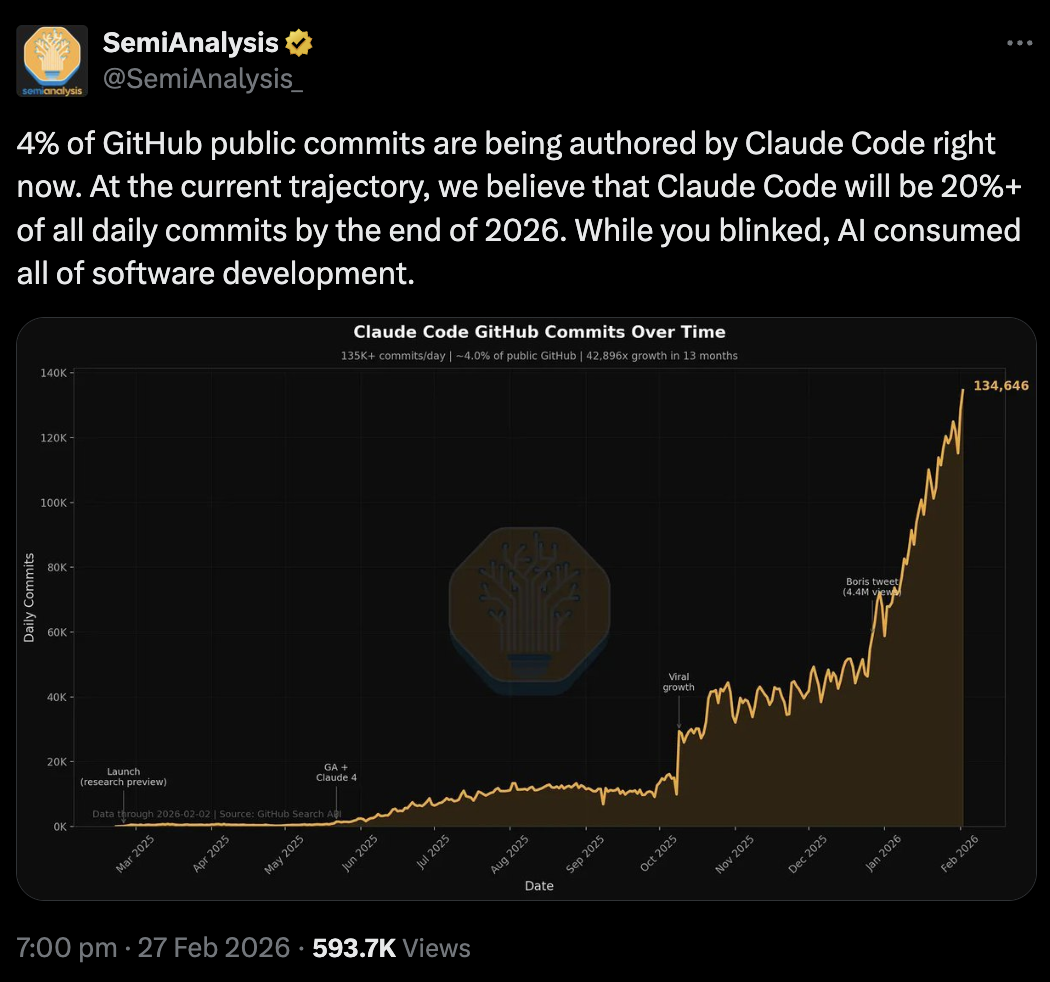
Let that sink in. One in five GitHub commits - within 12 months.
And we're still in the early innings. The cost and time to build software is falling fast. It will keep falling.
Herbie isn't the slowest hiker anymore. He just got a turbo engine.
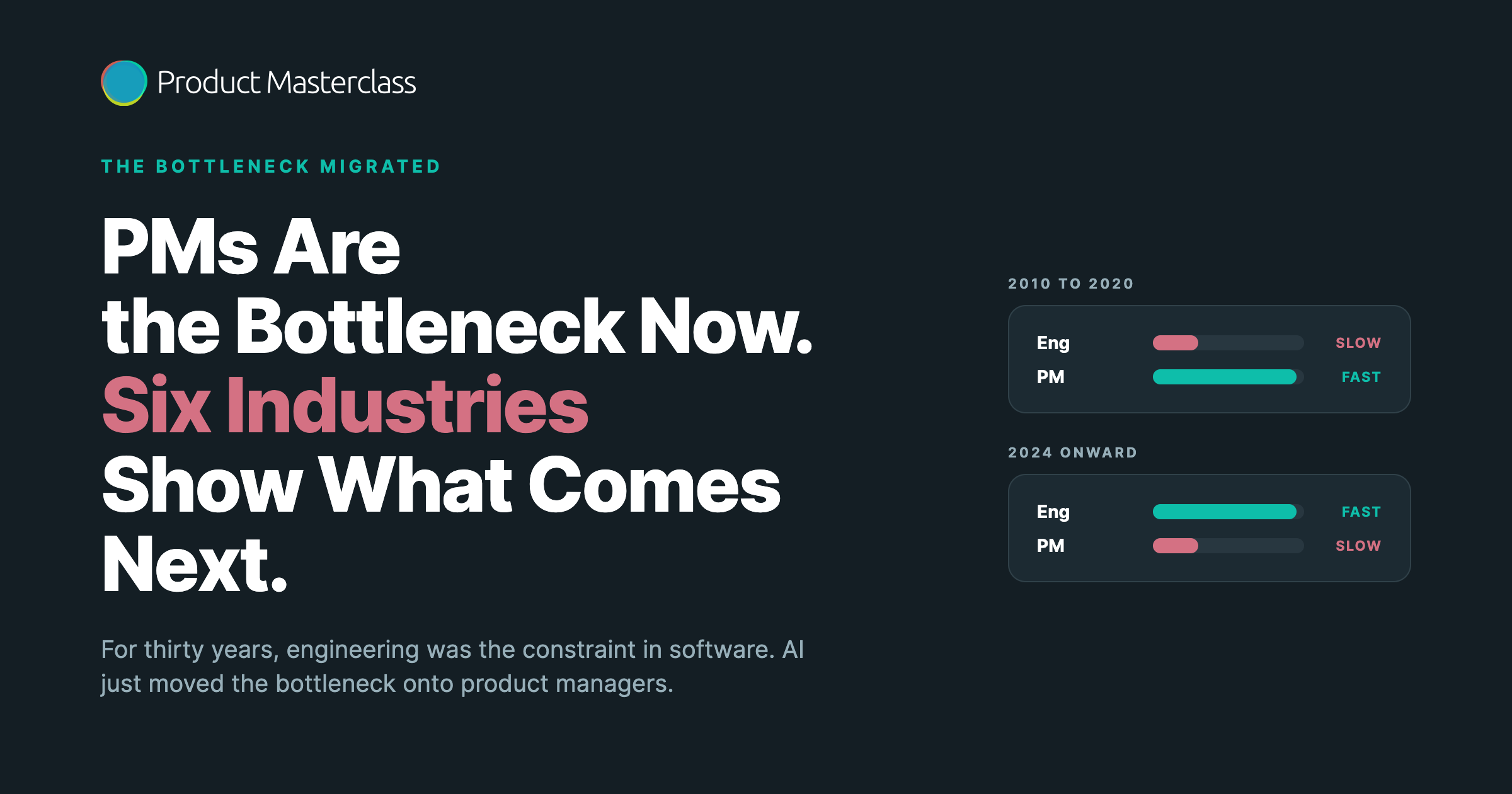
But here's what Goldratt taught us: when you speed up the bottleneck, you don't eliminate the bottleneck. You reveal the next one.
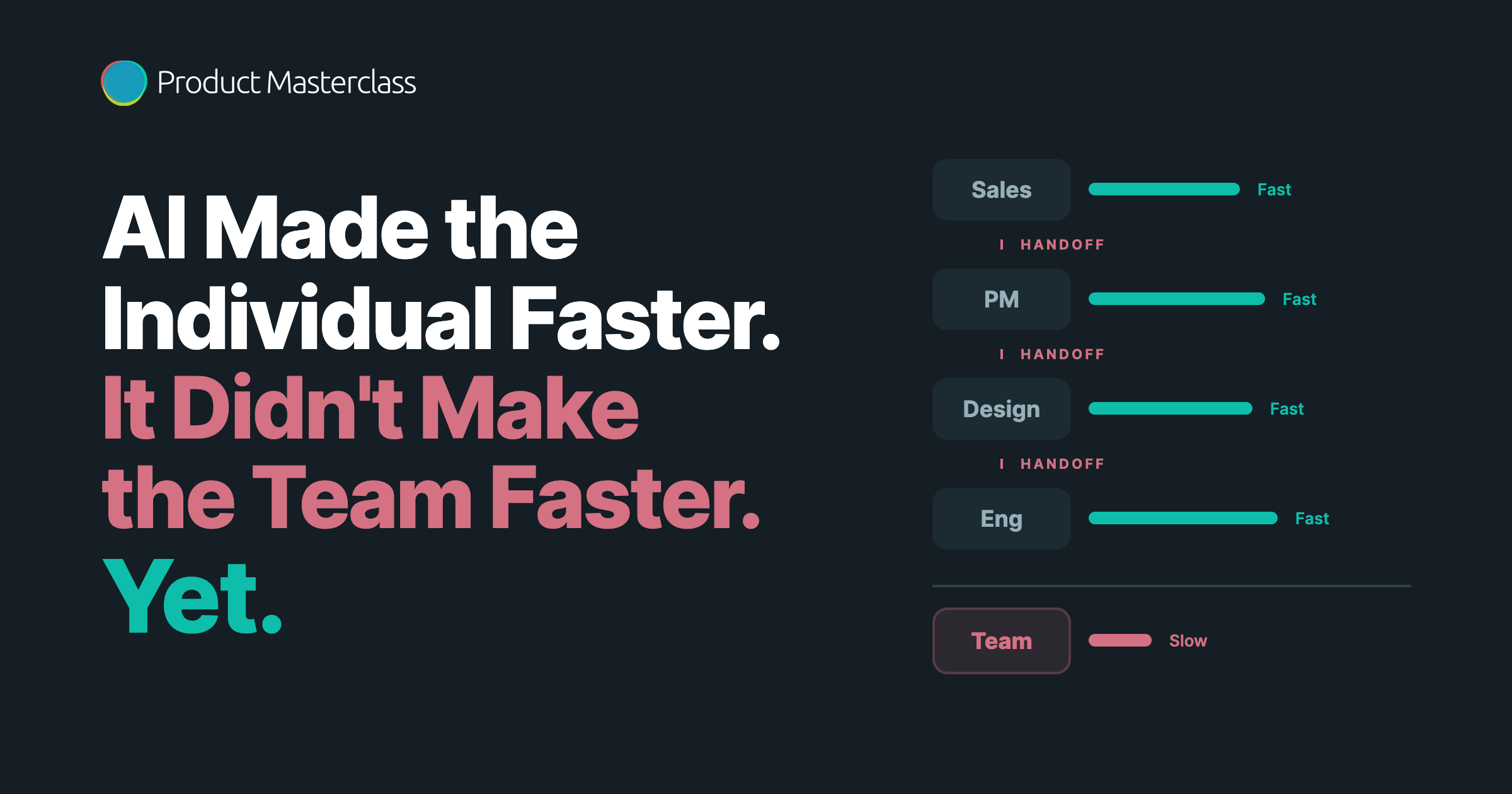
The group can only move as fast as its slowest member. When Herbie speeds up, someone else becomes Herbie.
So What's the New Constraint?
When building was expensive and slow, there was a natural forcing function on decisions. You couldn't build everything, so you had to be selective. The cost of implementation forced prioritisation. Debates about what to build were resolved partly by what was feasible to build.
Remove that constraint - and suddenly every idea is buildable. Every stakeholder request is achievable. Every feature on the wishlist becomes technically possible within days rather than months.
This sounds like good news. It isn't.
Because the hardest question was never "can we build it?" The hardest question was always "should we build it?" And that question just got a lot harder to answer.
The New Herbie: We Don't Know Yet - But Here Are Our Best Guesses
Here's the honest answer: nobody knows for certain what the new bottleneck will be. The shift is happening too fast, and the implications are still unfolding.
But after working with product teams across Europe for years, I have three strong candidates. I think one or all of them will define where organisations get stuck next.
Candidate 1: Product Thinking
Product Thinking is the ability to understand what customers actually need - not what they say they want, not what stakeholders request, not what feels like a good idea in a meeting room.
It requires talking to real customers. Sitting in their world. Understanding the job they're trying to do. Separating genuine pain points from noise. And then translating that understanding into clear, specific decisions about what to build next.
This has always been hard. But when building was slow, there was time to figure it out. A three-month development cycle gave you three months to validate the idea, refine the requirements, and course-correct before launch.
When building takes three days instead of three months, the speed of customer understanding needs to match the speed of production. And almost no organisation is set up for that.
The teams I talk to are investing heavily in AI coding tools. Almost none of them are investing proportionally in discovery - in the human skills, processes, and time required to deeply understand what customers actually need.
They're speeding up Herbie without asking who the new Herbie is.
Candidate 2: Strategy
Imagine you have perfect Product Thinking. You understand exactly what your customers need. You still have a problem: which customers?
With AI, you can theoretically build for every segment. Enterprise and SMB. Beginners and experts. Market A and Market B. Every customer request becomes buildable. The temptation to say yes to everyone is enormous.
But strategy is precisely this: the deliberate decision about who you want to be the best for - and, just as importantly, who you're willing to disappoint.
A product that's okay for everyone is rarely great for anyone. When building was expensive, this decision was partly made for you by necessity. You couldn't build everything, so you had to choose. AI removes that forcing function. And suddenly, the question "for whom do we want to be the best?" has no natural answer anymore. Nobody is forcing you to decide. And that's exactly when organisations lose their way.
Candidate 3: Distribution
This one is the most underestimated - and it was Rich Mironov who put it best at the Productized Conference in Lisbon last year: if you completely remove engineering from the bottleneck, you've still got to figure out how to price, package, sell, market, and support your product.
Imagine a world where you can spin up ten new software products a month. Your engineering team can do it. But can your sales team sell ten products? Can your marketing team position ten products clearly? Can your customer success team support ten products well?
The go-to-market machine doesn't scale automatically with AI. And most companies, in their current structure, have no idea how to handle 10x the output.
The Bottleneck Always Gets Paid Well
Here's a pattern worth paying attention to.
Goldratt was explicit about this in The Goal: the resource at the bottleneck is the most valuable resource in the entire system. A lost hour at the bottleneck is a lost hour for the whole organisation. Not just that one person - everyone.
That's why senior engineers got paid so well. Not just because of their technical skills. But because they were the constraint. Every hour they weren't productive cost the entire organisation. The market figured that out and priced it accordingly.
Now watch what happens when the bottleneck shifts.
If product thinking becomes the new constraint - the person who can deeply understand what customers need, who can separate signal from noise, who can translate fuzzy human problems into clear product decisions - that person becomes the most valuable person in the room. Not the fastest coder.
If strategy becomes the constraint - the person who can cut through the noise and say "this is who we're building for, and this is what we're not building" becomes the rarest and most expensive resource in the organisation.
If distribution becomes the constraint - the person who can take a product to market, build positioning that resonates, and create a go-to-market motion that scales - that person commands a premium nobody saw coming.
The market always follows the bottleneck. Compensation, budgets, hiring priorities, org chart weight - it all gravitates toward whatever is most scarce and most limiting.
So here is the practical question for every leader and every individual contributor reading this:
What are you optimising for? Are you doubling down on skills that are becoming abundant - or are you investing in the capabilities that are about to become the new constraint?
And for organisations: Where are you putting your budget? If you're still spending 80% of your people investment on engineering and almost nothing on discovery, strategy, and go-to-market - you may be funding the wrong Herbie.
What This Means for Your Organisation
Most organisations are not ready for this shift. And honestly - it's hard to blame them. The change is simply too rapid to adapt to. Organisations that spent decades building the perfect machine around one constraint can't rewire overnight.
They're doing everything right - for a constraint that is rapidly disappearing.
And to be fair - the full shift hasn't happened yet. Many companies are sitting on years of technical debt and backlogs so long that software still genuinely feels like the bottleneck. That feeling is real. It's not wrong.
But it's temporary.
The rate of improvement of Claude Code and similar tools will eliminate that over time. The question isn't whether engineering stops being the constraint. The question is when - and whether your organisation will be ready when it does.
So start asking now: if our engineers could ship 5x faster tomorrow, what would actually slow us down?
That's the question that exposes your new Herbie. And in most organisations I talk to, the answer is uncomfortable: it's the clarity about what to build. It's the alignment on who we're building for. It's the go-to-market motion that can't scale. It's the decision-making that gets stuck in committees.
The constraint has shifted. The org chart hasn't.
And here's what makes this particularly hard: the old Herbie was visible. You could see the backlog. You could count the engineers. You could measure velocity. The new bottlenecks - unclear strategy, shallow customer understanding, weak positioning - are invisible until they've already cost you.
The Question for Every Leader
Goldratt's insight was simple but profound: every system has a bottleneck, and your job is to find it.
For 30 years, most organisations didn't have to look hard. The bottleneck was obvious. It was the engineering team. And so the entire field of product management, agile methodologies, and software delivery optimisation grew up around that one constraint.
That constraint is loosening fast.
The organisations that will win in the AI era aren't the ones that move fastest to AI coding tools. They're the ones that ask - honestly, rigorously - where the new Herbie is hiding.
In most organisations I talk to, the answer is the same: it's not in engineering anymore. It's in the room where someone is supposed to decide what's worth building in the first place. And in the room where someone is supposed to decide who the company is really building for.
Direction, not code, is the new bottleneck.
The question is: is your organisation ready for that shift?
At Product Masterclass, we train product managers to work effectively in the AI era. Our 8-week intensive program covers everything from customer discovery and product strategy to working with AI tools in your daily workflow. Check out the next cohort
Discover where product management is heading
Stay up to date with our Product Newsletter and do not miss out on free articles, videos, templates, events on Product Management